
by Amruta Singh
If you spend your day recruiting inside Oracle HCM, you know exactly where the friction lives.
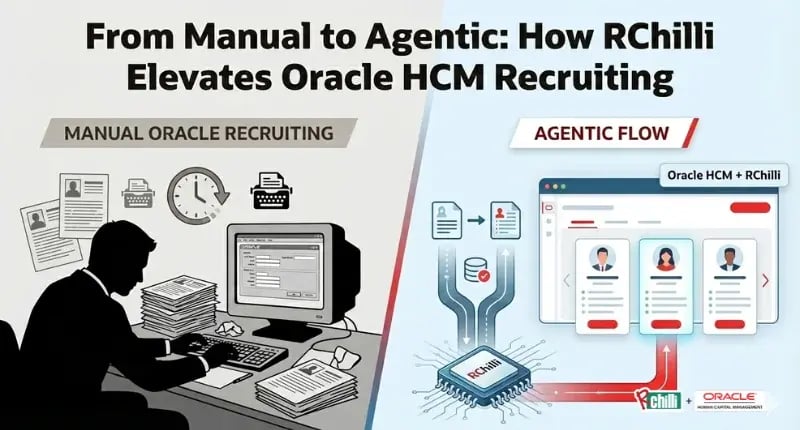
Resumes receive in various formats. Candidate profiles are often incomplete. Titles and skills aren’t standardized across regions. And when business leaders ask for faster hiring, the blocker usually isn’t sourcing—it’s the invisible time your team spends cleaning up data just so you can move forward.
That’s the space where RChilli is designed to help.
By weaving enhanced candidate profile import, enrichment, and data hygiene directly into Oracle HCM, RChilli turns manual, repetitive recruiting tasks into reliable background workflows. Instead of asking recruiters to behave like data entry operators, you let the system structure and clean talent data automatically, so your teams can focus on judgment and relationships.
Let’s look at how that works, and what it means for your recruiting reality.
The Hidden Cost of Manual Talent Data
Most Oracle HCM environments are well-designed from a process point of view: requisition approvals, offer flows, onboarding steps, and compliance checkpoints are clearly mapped.
Where things tend to break down is not the process chart—it’s the quality and consistency of the data flowing through it:
- -Resumes are uploaded as PDFs, DOCX files, and emails.
- -Recruiters or coordinators manually key details into Oracle candidate profiles.
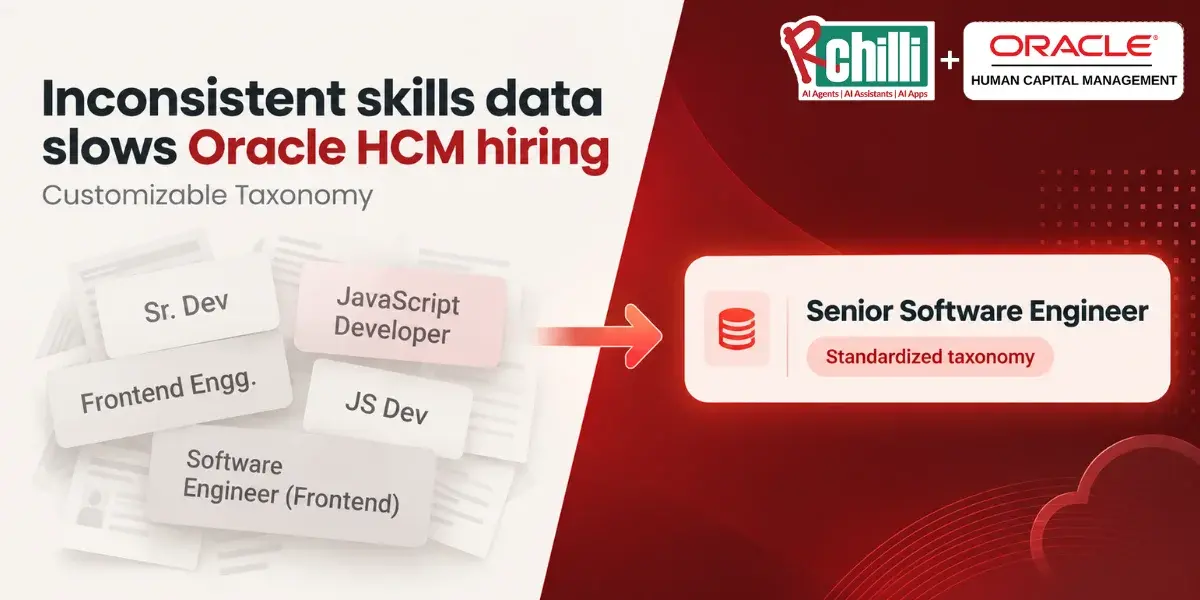
- -Job titles vary wildly for similar roles across geographies.
- -Skills are entered ad hoc or not captured at all.
- -Older profiles sit untouched, slowly drifting away from the candidate’s current reality.
The consequences show up everywhere:
- -Search results miss strong candidates because titles or skills aren’t aligned.
- -Matching and recommendations feel hit-or-miss.
- -Managers get shortlists later than they should.
- -Analytics dashboards exist, but leaders don’t fully rely on them because they know the input is messy.
This isn’t about people doing a bad job. It’s about a system that still relies heavily on manual effort for something machines are actually very good at: structuring unstructured information.
What RChilli Actually Does Inside Oracle HCM
RChilli integrates with Oracle HCM as a specialist for talent data and amplifies it.
Key capabilities include:
Enhanced Candidate Profile Import
When a candidate uploads a resume or one is ingested via your partners or job boards, RChilli:
- Extracts core details: name, location, contact information.
- Pulls out work experience, job titles, companies, dates.
- Captures education, certifications, skills, and other relevant fields.
- Maps all of this into the right Oracle HCM candidate or worker fields.
Instead of typing details line by line, recruiters see a structured profile appear almost instantly.
Multilingual and Global Support
Global HR teams deal with resumes in many languages. RChilli’s enhanced candidate profile import is designed to handle multi-language input while still mapping data into a consistent structure. That means a recruiter in Europe, Asia, or the Americas can rely on the same underlying data quality.
Taxonomy and Normalization
RChilli doesn’t just extract text; it understands context. Titles like “Account Executive,” “Sales Manager,” and “Client Partner” can all be normalized to a common taxonomy. Skills are standardized so that filters and searches in Oracle HCM behave predictably.
This is what makes your database feel searchable and comparable over time.
Seamless Oracle Experience
Everything happens within your Oracle environment. Recruiters do not need to jump between systems. The integration is designed to respect Oracle’s user experience and security model, so RChilli feels like a native extension.
Core Use Cases for Oracle HCM Teams
Different teams start in different places, but the most common entry points look like this:
1. High-Volume Hiring
For roles such as customer support, sales, or frontline operations, volume can be overwhelming. You might be dealing with hundreds or thousands of applications per month.
With RChilli:
- -Every resume becomes a structured profile.
- -Experience and skills are instantly visible.
- -Filters actually work because titles and competencies are normalized.
Recruiters stop spending evenings on data entry and can skim structured profiles to focus on high-value conversations.
2. Email and Bulk Imports
Many organizations still receive resumes via generic mailboxes or import legacy candidate data from older systems.
RChilli makes it possible to:
- Bulk parse historical resumes.
- Attach them to candidate records in Oracle.
- Preserve more context and detail than manual re-entry would allow.
This turns a one-time migration project into an opportunity to clean and standardize your entire database.
3. Ongoing Data Hygiene
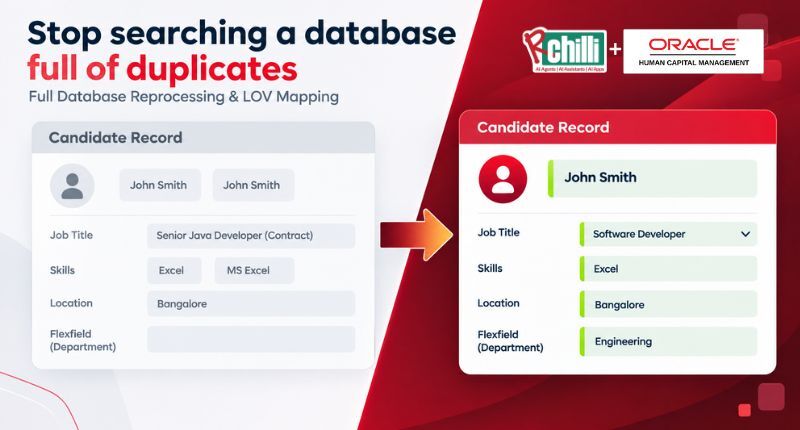
Even once profiles exist in Oracle HCM, they can drift over time. Titles change, skills evolve, and data from different periods doesn’t always align.
RChilli’s enrichment and normalization capabilities help:
- Standardize new data coming in.
- Re-align older profiles to match current naming conventions.
- Keep your dataset closer to “analytics-ready” at all times.
What Changes for Your Team
For recruiters, the change is immediate and tangible:
- Profiles are complete from day one.
- Search and filtering feel more reliable.
- Time spent on admin shrinks, creating room for deeper conversations with candidates and hiring managers.
For HR Ops and HRIS:
- Fewer tickets related to profile corrections.
- Less manual work during system upgrades or consolidation.
- Cleaner data feeding compliance reports and dashboards.
For TA leadership and HR:
- -More confidence in talent analytics.
- -A clearer view of internal and external talent pools.
- -A platform ready for more advanced AI scenarios, such as agents that refresh profiles or support predictive analytics.
A Simple Three-Step Roadmap
You don’t need to flip a switch across your entire Oracle HCM landscape on day one. A pragmatic approach looks like this:
- Start with Parsing for New Applicants
Activate RChilli for new candidates in a specific region or business unit. Make sure the mapping and taxonomy align with your standards. - Normalize Data for Key Talent Pools
Choose one or two critical role families—sales, engineering, operations—and use bulk parsing and enrichment to clean and standardize those candidate profiles. - Expand and Layer Intelligence
Once the foundation is solid, extend parsing and enrichment to more geographies and functions. From there, explore AI agents that can refresh profiles and support more advanced decision-making.
The goal isn’t to turn Oracle HCM into something else. The goal is to let it do what it does best, powered by talent data that finally keeps up with the speed of your business.


Leave a Reply