
by Amruta Singh
Think about what a recruiter's week actually looks like.
A job posting goes live. A few hundred applications pour in. Someone needs to read them, log the data, respond to the ones worth pursuing, coordinate times with the hiring manager, reschedule the ones that fall through, follow up with candidates who've gone quiet — and do all of this while managing six other open roles simultaneously.
None of that is what great recruiters went into recruiting to do. It's administrative overhead. And it's exactly the kind of work AI agents are built to handle.
This blog breaks down how AI agents embedded in HCM (Human Capital Management) systems are reshaping talent acquisition — not as a futuristic concept, but as something happening right now inside platforms like Workday, SAP SuccessFactors, Oracle Recruiting Cloud, and ADP Workforce Now.
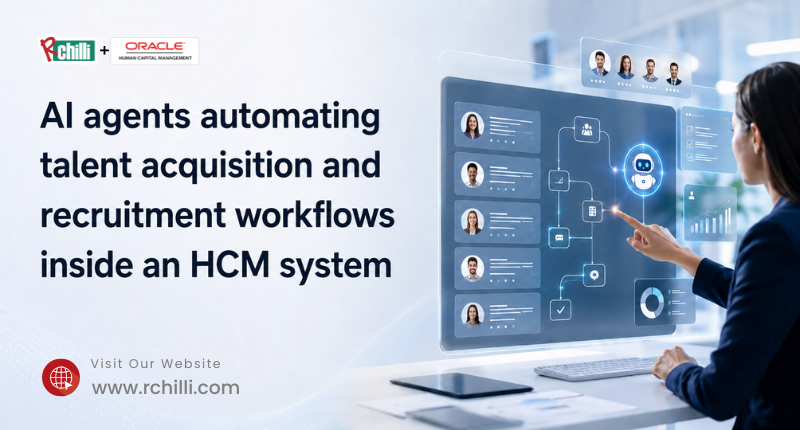
What Exactly Is an AI Agent in an HCM System?
Before getting into specifics, it's worth clarifying what we mean — because "AI" gets applied to a lot of things that aren't really AI agents.
An AI agent in an HCM system is a program that can perceive data, make decisions about it, take action, and learn from outcomes — all without waiting for a human to tell it what to do next.
That's meaningfully different from an automation rule that filters resumes by keyword, or a chatbot that reads from a script. Agents are adaptive. They handle nuance. They get smarter as they accumulate data about your specific hiring context. Crucially, they also write outcomes back into the HCM platform — so every action is visible, auditable, and under recruiter control.
Here's a quick look at where they show up across the recruitment lifecycle:
|
Recruitment Stage |
What AI Agents Do |
|---|---|
|
Job Description |
Draft, optimize, and audit JDs for bias and market relevance |
|
Resume Data Extraction |
Pull and structure candidate data from any file format |
|
Candidate Matching |
Rank applicants by real fit — not just keyword overlap |
|
Communication |
Keep candidates informed 24/7, in any language |
|
Interview Scheduling & Prep |
Coordinate availability and generate role-specific questions |
|
Screening |
Run structured assessments consistently across all applicants |
|
Profile Enrichment |
Keep talent data accurate, complete, and re-discoverable |
|
Compliance |
Log every decision and enforce data retention policies |
|
Analytics |
Spot patterns in hiring data to improve future decisions |
1. How Do AI Agents Improve Job Description Quality?
Most job descriptions are written in a rush. They're copied from a previous version, updated with a few bullet points, and posted before anyone has thought carefully about what the role actually requires — or who it might be quietly turning away.
AI agents fix this by analyzing what's worked historically and using that knowledge to generate better, more inclusive descriptions from the start.
The numbers here are striking. Manually drafting and refining a job description typically takes one to two hours. AI-powered job description optimization cuts that to five to ten minutes — an 85–90% reduction in time. More importantly, when job descriptions are rewritten with inclusive, market-aligned language, candidate quality improves. Optimized postings have been shown to improve applicant relevance by as much as 10–25%, simply because the right people recognize themselves in the role.
-
- Flag gendered or exclusionary phrasing before the JD goes live
-
- Recommend skills and qualifications benchmarked against current market data
-
- Ensure DEI compliance from the very first line of the posting
-
- Align requirements with internal compensation bands so expectations match reality
A good job description is the first filtering layer in recruitment. Getting it right matters more than most teams realize.
2. How Do AI Agents Automate Resume Data Extraction in HCM Systems?
Here's something that doesn't get talked about enough: a huge portion of recruiter time goes into moving data from one place to another. Candidate applies. Someone copies name, email, job title, skills, and education into the ATS. Multiply that by hundreds of applications for a single role and you start to see the problem — not just the time lost, but the errors introduced.
AI-powered resume data extraction handles this automatically — pulling structured information from any file format and loading it directly into the HCM system the moment a resume arrives.
- Works across PDFs, Word documents, HTML pages, and LinkedIn profiles without manual reformatting
-
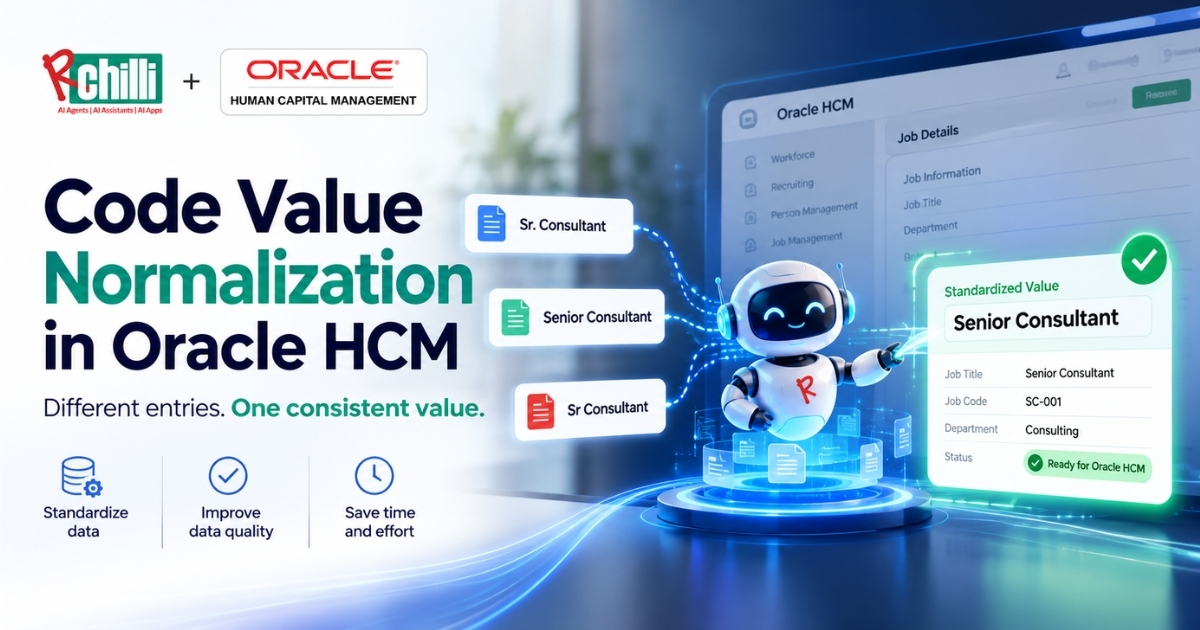
- Normalizes job titles and skills against standard taxonomies so data is consistent and searchable
-
- Eliminates the typos, missed fields, and formatting errors that plague manual entry
-
- Makes every candidate profile immediately usable for downstream matching and analytics
RChilli's AI-powered resume data extraction engine processes documents in 140+ languages, handles every major file format, and integrates natively with Oracle Recruiting Cloud and other leading HCM platforms — so structured, enriched candidate data flows in from day one.
No more data entry. No more candidates lost in formatting inconsistencies. Just reliable profiles ready for the work that actually matters.
3. How Do AI Agents Match Candidates to Jobs More Accurately?
Keyword matching has always been a blunt instrument. It rewards candidates who know how to stuff their resume with the right terms, and it quietly sidelines people who are genuinely qualified but describe their experience differently.
AI agents approach matching the way a thoughtful recruiter would — by looking at the substance of someone's background, not the surface vocabulary.
When AI-driven application analysis is applied, manual review time drops dramatically — from ten to fifteen minutes per candidate to two to three minutes — without sacrificing accuracy. In fact, automated scoring typically improves shortlisting precision, because it eliminates the inconsistency and fatigue that creep into manual review at high volumes.
-
- Evaluate career trajectory and how skills have developed over time
-
- Assess transferable expertise across adjacent roles and industries
-
- Generate match scores, skill gap analyses, and ranking — all visible inside the HCM platform
-
- Refine matching criteria automatically as more hiring data accumulates
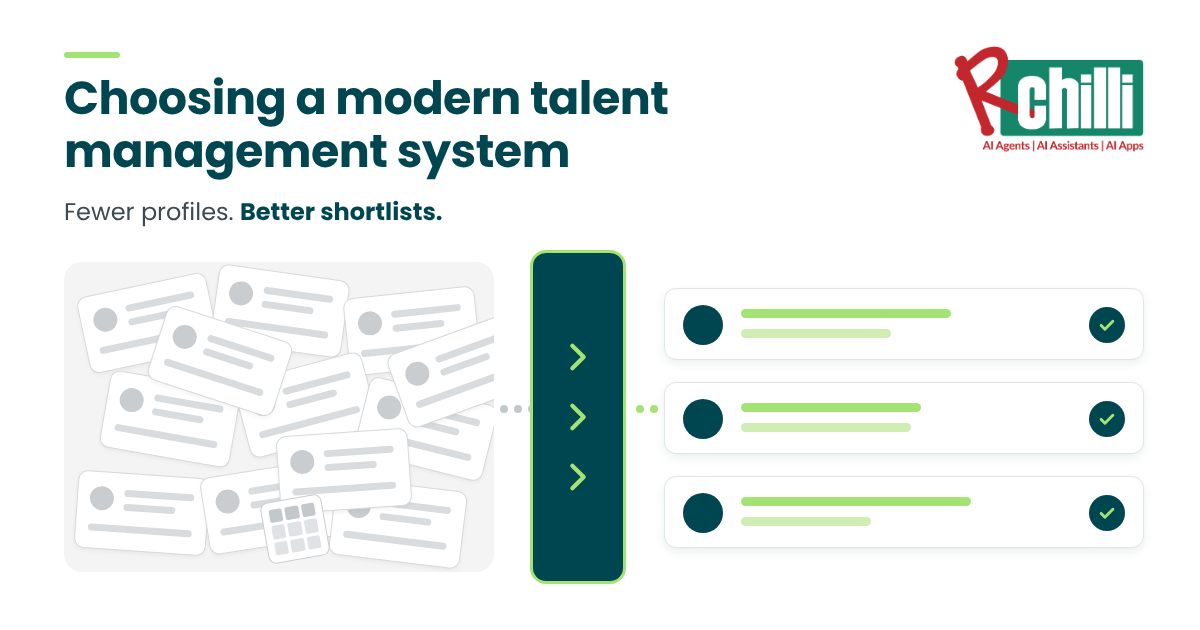
The practical result: your shortlist is smaller, more relevant, and far less likely to include people who look good on paper but aren't actually right for the role.
4. How Do AI Agents Improve the Candidate Experience?
Put yourself in a candidate's position for a moment. You spend an hour tailoring your resume and cover letter. You submit the application. Then — nothing. Days pass. Sometimes weeks. You don't know if the application was received, whether you're being considered, or whether to keep waiting.
That silence is a choice. And it's one that costs companies.
AI agents eliminate communication gaps automatically — keeping every applicant informed at every stage, without a recruiter needing to send a single message manually.
-
- Acknowledge applications immediately and personally, not with a generic autoresponse
-
- Send stage-by-stage updates so candidates always know where they stand
-
- Handle common questions through conversational chat — available at midnight just as readily as at noon
-
- Deliver rejection messages with enough context to feel respectful rather than dismissive
-
- Reduce candidate drop-off at every stage of the funnel
Sixty percent of candidates who have a poor application experience share it — on Glassdoor, on LinkedIn, in conversations with colleagues. AI agents protect your employer brand at the scale where brand damage actually happens.
5. How Do AI Agents Solve the Interview Scheduling and Preparation Problem?
If you've ever tried to schedule a four-person panel interview with a candidate in a different time zone, you know how this goes. Twelve emails. Three reschedules. Someone joins late because they had the wrong link. And that's before anyone has even started thinking about what questions to actually ask.
AI agents address both sides of this problem — coordinating logistics automatically and generating role-specific interview questions without manual preparation.
On the scheduling side, agents integrate with calendar systems across all stakeholders, identify mutual availability, confirm bookings, send reminders, and handle last-minute rescheduling without human intervention.
On the preparation side, the impact is equally significant. Manually preparing structured, role-relevant interview questions typically takes recruiters and hiring managers 30 to 50 minutes per candidate. AI agents generate those questions — tailored to the job requisition, the candidate's profile, and the interview format (technical, behavioral, competency-based) — in a fraction of that time, reducing preparation effort by up to 80–85%. For high-volume hiring teams, that translates to more than 50 recruiter hours saved every month.
- Generate structured, balanced question sets covering technical, behavioral, and soft skill dimensions
-
- Save up to 5–10 minutes of preparation time vs. 30–50 minutes manually
-
- Coordinate multi-stage interview loops end-to-end — from phone screen to executive panel
-
- Push approved questions directly back into the candidate record within the HCM platform
Better-prepared interviewers ask better questions. Better questions lead to better hiring decisions.
6. How Do AI Agents Conduct Candidate Screening Consistently?
Initial phone screens exist to answer a few basic questions: Can this person communicate clearly? Do they meet the fundamental requirements? Are their salary expectations in range? But the way those questions get asked — and evaluated — varies enormously from recruiter to recruiter.
AI agents standardize this process by conducting structured preliminary assessments, applying the same criteria to every candidate every time.
The efficiency gains here are substantial. Manual resume screening takes seven to ten minutes per candidate on average. AI-driven pre-screening cuts that to one to two minutes — a 75–85% reduction. That means a recruiter who previously screened twenty candidates a day can now meaningfully evaluate sixty to eighty.
-
- Conduct AI-led text or audio-based screening interviews at scale
-
- Assess communication skills, baseline job fit, and role-specific criteria consistently
-
- Generate standardized insights and recommendations for every applicant
-
- Update results directly in the HCM platform for recruiter review
The result isn't just efficiency. It's fairness. Every candidate gets the same quality of evaluation, regardless of which recruiter is having a busy day.
7. How Do AI Agents Reduce Hiring Bias?
Bias in hiring is a real problem — not because recruiters are bad people, but because human judgment is inconsistent. The same resume reviewed on a Monday morning gets evaluated differently than on a Friday afternoon. Candidates with familiar-sounding names get more callbacks. Interviewers favor people who remind them of themselves.
AI agents can't eliminate bias entirely, but they significantly reduce the inconsistency that allows it to compound.
-
- Apply the same evaluation criteria to every candidate, every time — regardless of name, age, gender, or institution
-
- Flag and replace job description language that discourages qualified applicants from applying
-
- Track outcomes by demographic segment so disparities surface in data rather than staying invisible
-
- Generate evidence-based audit trails that make bias reviews concrete rather than theoretical
One honest caveat: AI agents reflect the data they learn from. If historical hiring data contains bias, unchecked AI can replicate it. Fairness guardrails, regular audits, and human oversight are non-negotiable parts of responsible AI recruitment.
8. How Do AI Agents Help Manage Talent Pipelines?
Not every strong candidate is available when you need them. Some are passively open to opportunities but not actively looking. Others interviewed well but the timing wasn't right. Without a system to stay in touch, those relationships fade and you end up sourcing from scratch every time a role opens.
AI agents keep your talent pipeline warm automatically — maintaining relationships at a scale no human team could manage manually.
-
- Segment candidates by skills, role family, geography, and past engagement
-
- Reach out with relevant opportunities at the right moment, referencing prior interactions so messages feel personal rather than mass-produced
-
- Track engagement signals — opens, clicks, event registrations — and surface ready-to-engage candidates to recruiters automatically
-
- Gradually reduce the cost and time associated with external sourcing as your pipeline grows more robust
9. How Do AI Agents Support Internal Mobility?
Here's an uncomfortable truth: most companies are better at finding external candidates for open roles than they are at identifying internal ones. Someone two departments over might be a perfect fit, but without a system that surfaces that match, neither the hiring manager nor the employee ever knows.
AI agents solve this through continuous profile enrichment — keeping every employee's talent record accurate, current, and discoverable within the HCM system.
Manually updating and maintaining candidate profiles takes ten to twenty minutes per profile. Automated profile enrichment completes the same task in one to two minutes, reducing maintenance effort by 85–90%. More importantly, well-maintained profiles improve the rediscovery of existing candidates by 20–30% — meaning internal talent that would otherwise go unnoticed becomes visible when the next role opens.
-
- Automatically enrich profiles with new skills, certifications, and role experiences
-
- Keep internal talent pool data accurate without requiring manual updates
-
- Rank internal candidates against external applicants with the same rigor
-
- Help organizations improve retention by showing high-potential employees there's room to grow inside
10. How Do AI Agents Enable Predictive Hiring Analytics?
Most organizations have years of hiring data sitting unused inside their HCM systems. Which sourcing channels actually produced their best performers? Which interview questions turned out to be predictive? Which roles are consistently hard to fill — and why? The answers are in the data. The problem is that nobody has time to analyze it manually.
AI agents do this analysis continuously, turning historical patterns into forward-looking guidance that shapes every recruitment decision.
-
- Surface which sourcing channels deliver the highest quality-of-hire for specific role types
-
- Reveal which assessments and interview questions correlate with long-term success
-
- Flag teams or departments where skills gaps are developing before those gaps create real problems
-
- Help HR leaders optimize sourcing spend based on actual ROI rather than habit
11. How Do AI Agents Simplify Recruitment Compliance?
Employment law is complicated and it keeps changing. Data privacy requirements vary by country. Equal opportunity reporting has its own rules. And when something goes wrong — whether it's an audit, a complaint, or litigation — the question is always the same: can you document what you did and why?
AI agents generate that documentation automatically as a byproduct of the work they're already doing.
A well-designed AI recruitment agent operates on a read–analyze–write model: it pulls data from the HCM platform, applies intelligence, and writes structured results back into the platform after recruiter review. Every step is logged. Every decision is traceable. Recruiter control is preserved at each stage.
-
- Log every candidate interaction and hiring decision with the criteria that were applied
-
- Enforce data retention and deletion schedules based on jurisdiction-specific rules
-
- Manage candidate consent throughout the process — capturing it, recording it, honoring it
-
- Produce diversity and compliance reports without manual aggregation or spreadsheet work
When audit time comes, the records are already there.
12. Do AI Agents in HCM Systems Actually Get Better Over Time?
Yes — and this is the part that separates AI-native talent acquisition from everything that came before it.
Every hire made, every candidate rejected, every offer accepted or declined generates data that feeds back into the system and sharpens its future decisions.
-
- Candidate ranking improves as the system learns what success looks like in your specific organization
-
- Matching criteria evolve as role requirements, team structures, and performance benchmarks shift
-
- Automation becomes more effective as edge cases are encountered and resolved
Manual processes don't compound like this. A recruiter who's been in the job for a year is more experienced — but that learning doesn't automatically scale across the team. AI agents carry institutional knowledge forward, indefinitely, at no additional cost.
What Makes All of This Work? Clean Data at the Source.
There's a version of this blog that glosses over this point and jumps straight to the benefits. But it would be doing you a disservice.
Every capability described above — the matching, the screening insights, the profile enrichment, the predictions — depends entirely on the quality of the candidate data flowing into your HCM system. If that data is incomplete, inconsistently formatted, or poorly structured, the AI agents built on top of it underperform. Garbage in, garbage out is as true for AI as it's ever been.
Resume data extraction is where that foundation gets built — or doesn't.
When a candidate submits a resume, the information needs to be pulled out accurately and translated into a structured profile that every downstream system can use. Job titles normalized. Skills mapped to a consistent taxonomy. Education, certifications, and work history extracted without errors or omissions. And when those profiles need to be refreshed over time — because skills change, certifications expire, roles evolve — an enrichment layer keeps the data current automatically.
RChilli's resume data extraction and enrichment solutions do exactly this — handling documents in 140+ languages, across every major file format, and connecting directly with Oracle Recruiting Cloud and other leading HCM platforms. The result is AI-ready candidate data from the first moment it enters your system, and a talent pool that stays accurate long after initial ingestion.
Frequently Asked Questions
Q: What is an AI agent in recruitment?
An AI agent in recruitment is a software program that can act on talent data independently — reading resumes, ranking candidates, generating interview questions, conducting pre-screens, and flagging compliance issues — without needing a human to initiate each step. Unlike rule-based automation, it adapts based on outcomes and improves over time.
Q: How is this different from what our ATS already does?
Most ATS platforms automate specific, narrow tasks based on fixed rules: if a resume contains the word "Python," advance it; if not, filter it out. AI agents work differently — they evaluate context, weigh relevance, handle exceptions, and update their own logic based on what they learn. It's the difference between a checklist and a judgment call.
Q: Which HCM platforms support AI agent capabilities?
Workday, SAP SuccessFactors, Oracle Recruiting Cloud, and ADP Workforce Now have all integrated AI-driven features. Beyond native capabilities, third-party AI layers can extend intelligent recruitment workflows to virtually any ATS or HCM system — including legacy platforms that weren't built with AI in mind.
Q: Will AI agents make our hiring less biased?
They can — but only if they're set up carefully and monitored regularly. AI agents that apply consistent criteria across all candidates reduce the inconsistency where bias thrives. Inclusive job description optimization, standardized screening assessments, and demographic outcome tracking all contribute to fairer hiring. But human oversight remains essential — AI reflects the patterns in the data it trains on.
Q: What data does an AI agent actually need to function?
At minimum: structured candidate profiles extracted from resumes and applications, job descriptions, and ideally some historical hiring outcome data. The richer and more consistent that data is, the better the agent performs. Resume data extraction is the step that turns unstructured documents into usable input.
Q: How quickly will we see results?
Most organizations see measurable improvements in time-to-hire and recruiter capacity within the first 90 days. Predictive and matching capabilities improve more gradually — typically over six to twelve months as the system accumulates enough data about your specific hiring context to refine its recommendations.
The Bottom Line
Great recruiters aren't slow because they're not working hard enough. They're slow because a significant portion of their day is spent on work that has nothing to do with what makes them good at their jobs — the judgment, the relationships, the instinct for culture fit that no system can replicate.
AI agents absorb that overhead. They handle job description drafting, resume data extraction, candidate screening, application analysis, interview preparation, profile enrichment — and they do it consistently, at any hour, without fatigue. For high-volume hiring teams, that can add up to hundreds of recruiter hours saved annually. What gets handed back is time and focus for the work that actually moves the needle.
Build the right data foundation. Deploy the right agents at the right stages. Then let your recruiters do what they're actually there to do.
RChilli is trusted by 1600+ customers and partners across 50+ countries. Our AI-powered resume data extraction, enrichment, and talent intelligence solutions — including AI agents purpose-built for Oracle Recruiting Cloud — help hiring teams work faster, smarter, and with more confidence at every stage of talent acquisition.


Leave a Reply