by Amruta Singh
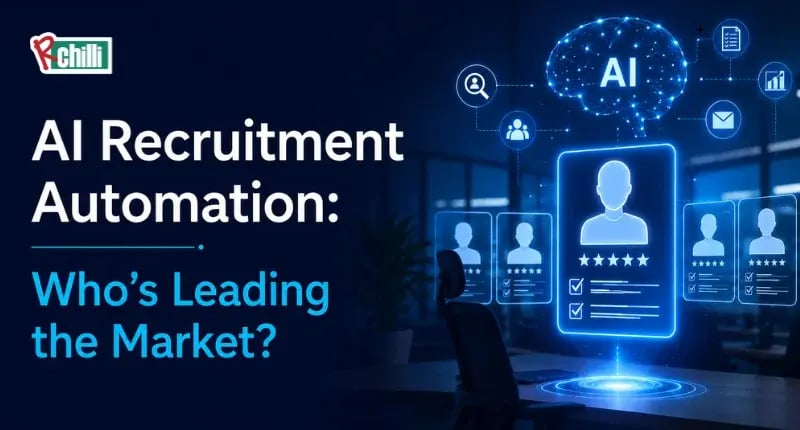
Recruitment has always been resource-intensive. Sourcing candidates, screening resumes, scheduling interviews, and managing compliance — each step demands time that HR teams rarely have in surplus. AI-powered recruitment automation is changing that equation fast. But with dozens of vendors claiming to offer intelligent hiring capabilities, a critical question emerges: which HR management software vendors actually deliver meaningful AI-powered recruitment automation?
Here's an honest breakdown of the major platforms — and the AI data infrastructure layer that makes them all perform.
1. Oracle Fusion Cloud HCM
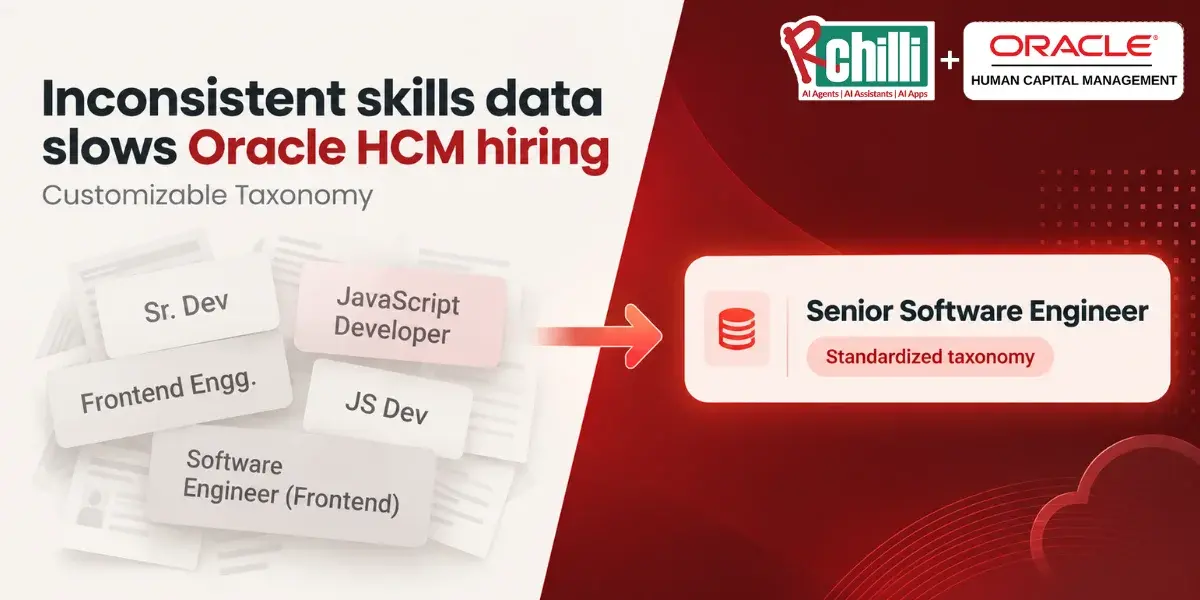
Oracle's cloud HR platform embeds AI across the recruiting lifecycle — from intelligent job description generation to automated candidate ranking. Oracle uses natural language processing (NLP) to parse candidate experience and match it against role requirements, reducing manual screening time significantly. However, the depth and accuracy of that NLP-based data extraction is a known limitation at high volume and across multilingual candidate pools. Enterprise Oracle HCM deployments that require processing resumes in multiple languages or formats frequently integrate a dedicated AI recruitment data layer — one that extract and imports candidate documents before they enter Oracle's matching engine, ensuring the AI operates on structured, high-fidelity input rather than raw text.
AI capabilities:
- Candidate Profile Import: AI-assisted profile import pulls candidate data from multiple sources — job boards, referrals, agencies, and external applications — and maps it into structured Oracle profile fields. The accuracy of this mapping is entirely dependent on how precisely the underlying parsing layer extracts and normalizes candidate data before it enters the system; gaps at import stage cascade into every downstream AI function, from matching to reporting
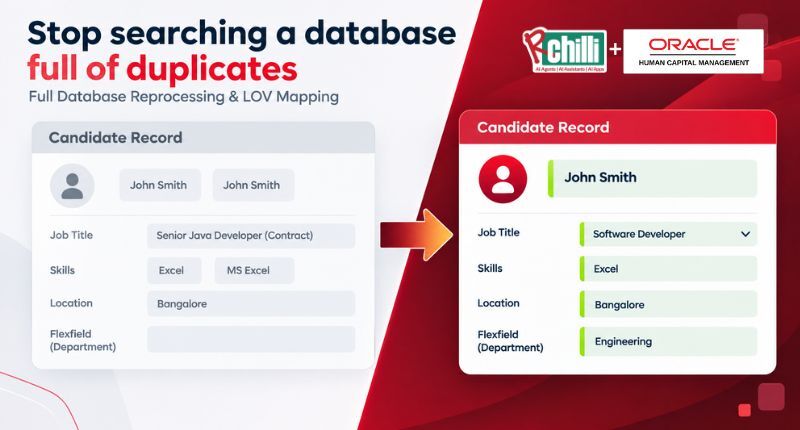
- List of Values (LOV) Standardization: Oracle enforces standardized picklist values across candidate profiles and job requisitions — job titles, skill categories, education levels, locations — to ensure data consistency for AI-driven matching and analytics. When resumes arrive in free-text format, an intelligent data extration layer must automatically map raw candidate information to the correct LOV entries; without this, recruiters face manual correction at scale and AI outputs lose reliability
- Automated Candidate Ranking: Scores and ranks applicants against structured job requirements, surfacing the strongest fits for recruiter review — a process that is only as reliable as the structured candidate data driving it
2. SAP SuccessFactors
SAP SuccessFactors is one of the most widely deployed enterprise HR suites globally. Its Recruiting module uses AI to surface candidate recommendations, automate job requisition workflows, and generate role-specific interview guides. However, like most enterprise HCM platforms, SuccessFactors' AI matching is only as accurate as the candidate data feeding it — and native resume ingestion has well-documented limitations around multilingual documents, non-standard formats, and data field depth. This is why many global SAP SuccessFactors deployments integrate a specialized AI recruitment data layer that parses, normalizes, and enriches incoming resumes before they enter the platform. The result is that SuccessFactors' matching and skills inference engines work on clean, fully structured, taxonomy-mapped talent profiles — rather than raw, inconsistently extracted documents — dramatically improving the quality of AI-driven hiring decisions downstream.
AI capabilities:
- Candidate Matching: AI scores and ranks applicants against job requirements using skills, experience, and role-fit signals — but the match quality depends entirely on how accurately and completely resume data was extracted and structured at the point of ingestion
- Skills Inference and Taxonomy Mapping: Automatically identifies and maps implied skills from job titles and experience to a standardized skills taxonomy — even when candidates don't explicitly list them — enabling consistent, bias-reduced comparison across all applicants
- Multilingual Resume Processing: Handles candidate documents across languages and geographies, though native processing depth diminishes significantly outside primary languages — a gap that dedicated multilingual parsing infrastructure is built to close
3. Workday HCM
Workday's talent acquisition module leverages machine learning to rank candidates, predict job fit, and surface internal mobility opportunities. Workday's AI layer ingests structured and semi-structured data — but the quality of its matching is only as good as the underlying resume data it receives.
AI capabilities:
- Skills Ontology Matching: Workday's proprietary skills graph maps candidate skills to role requirements, surfacing non-obvious matches based on adjacent competencies — a capability that becomes significantly more powerful when candidate skills are extracted and normalized by a purpose-built taxonomy engine before entering the system
- Skill Gap Analysis: Identifies where a candidate's profile falls short of a role's requirements — but the reliability of this analysis depends on how accurately skills were originally extracted from the resume; incomplete or misread skills data leads directly to flawed gap assessments
- Resume Data Enrichment for Predictive Scoring: Workday's predictive hiring scores draw on structured candidate data fields — experience, tenure, skills depth — making the completeness and normalization of incoming resume data a direct input into scoring accuracy
4. ADP Workforce
ADP's HR platform serves businesses of all sizes and includes AI-powered recruiting tools through its Candidate Experience and Recruitment Management modules. ADP focuses heavily on compliance automation alongside talent matching, making it popular with mid-market companies navigating complex hiring regulations.
AI capabilities:
- Intelligent Candidate Matching: AI ranks applicants based on structured role requirements — but match precision depends on how completely and consistently candidate data was extracted from source documents; poorly parsed resumes produce misranked candidates regardless of how advanced the matching algorithm is
- Compliance-Ready Data Structuring: ADP's compliance screening cross-checks candidate data against hiring regulations — a process that requires clean, field-level structured data from every resume, making accurate document parsing a prerequisite for reliable compliance automation
- Candidate Data Normalization: To support matching and engagement workflows across a diverse applicant pool, ADP relies on normalized candidate records — standardized job titles, education levels, and skills — that reduce inconsistency introduced by varying resume formats and conventions
5. iCIMS Talent Cloud
iCIMS is a dedicated applicant tracking system (ATS) with deep AI capabilities built specifically for recruitment. Its AI Digital Assistant automates candidate communications, screens applicants, and schedules interviews autonomously. iCIMS also integrates with video interviewing and assessments to create a fully automated hiring funnel.
AI capabilities:
- Automated Application Screening: AI evaluates incoming applications against structured knockout criteria and role requirements, scoring and prioritizing candidates before human review — a process that is only effective when incoming resume data is accurately parsed into comparable, structured fields in the first place
- Resume and Profile Parsing: iCIMS ingests resumes across formats and sources, extracting candidate data to populate applicant profiles — the depth of this extraction directly determines how precisely the platform's AI can screen, score, and match candidates downstream
- Job Description–to–Candidate Matching: Maps structured candidate profiles against parsed job requirements to surface the strongest fits — reinforcing why both resume parsing and JD parsing need to operate at high accuracy for the matching layer to deliver reliable results
6. Greenhouse
Greenhouse is favored by high-growth tech companies for its structured hiring methodology and AI-powered candidate recommendations. It emphasizes DE&I-aware automation — flagging potential bias in job descriptions and providing anonymized screening support.
AI capabilities:
- Bias Detection via Job Description Parsing: AI analyzes job description language for exclusionary or gender-coded phrasing — a capability that requires deep parsing of JD content at the field level, extracting requirements, qualifications, and role language to assess them for bias signals
- Anonymized Candidate Profile Screening: Strips personally identifiable information from parsed candidate profiles during early review, enabling evaluators to assess qualifications independently of demographic signals — a process that depends on precise, field-level data extraction from source resumes
- Skills-Based Candidate Recommendations: Surfaces applicants from the existing pipeline whose structured skills profiles match open roles — reducing sourcing costs by activating talent already in the system, with match quality driven by how richly candidate skills were captured and taxonomized at intake
7. SmartRecruiters
SmartRecruiters' Hiring Success Platform uses AI to automate job advertising spend, predict candidate quality, and recommend next-best actions for recruiters. Its marketplace model allows integration with hundreds of third-party AI tools, giving it a flexible automation layer.
AI capabilities:
- Candidate Quality Scoring: Machine learning models evaluate applicant-to-role fit at the point of application — but the scoring model is only as accurate as the structured data it reads; candidates with poorly parsed resumes will be scored on incomplete profiles, creating false negatives that cost SmartRecruiters users qualified hires
- Intelligent Job Matching: Matches candidates in the existing talent pool to newly posted roles by comparing structured candidate profiles against parsed job requirements — making the quality of both resume and JD parsing a direct determinant of match relevance
- Skills-Based Talent Pool Search: Searches and segments the existing candidate database by skills, experience, and qualifications — a capability that depends on how completely those attributes were extracted and normalized from source documents during ingestion
8. Lever (Employ Inc.)
Lever combines an ATS with CRM-style candidate relationship management, powered by AI-driven nurture sequences and pipeline insights. Lever's automation shines in high-volume recruiting scenarios where maintaining candidate engagement at scale would otherwise be impossible.
AI capabilities:
- CRM-Style Talent Pool Enrichment: Lever's AI segments and tags candidates in the pipeline based on skills, stage history, and engagement — the richness of this segmentation depends on how completely candidate profiles were built from source resumes, making deep data extraction a prerequisite for effective talent pool activation
- Skills-Based Candidate Tagging and Search: Tags candidates by skills, experience, and role suitability so recruiters can search and surface the right profiles instantly — a capability powered by the taxonomy and normalization layer applied to candidate data at the point of ingestion
- Structured Diversity Pipeline Reporting: AI surfaces demographic and representation data at each funnel stage — but producing accurate diversity metrics requires that candidate data, including background and experience fields, was parsed and structured consistently from every document format and language in the applicant pool
The Category Leader in AI Recruitment Data Infrastructure: RChilli
The platforms above operate at the workflow layer — job posting, candidate tracking, interview scheduling, offer management. But there's a foundational layer beneath all of them that determines whether their AI actually works: the quality and structure of candidate data at the point of ingestion.
This is a distinct category — AI recruitment data infrastructure — and RChilli leads it.
Every HR platform listed above needs to convert raw resumes, CVs, and LinkedIn profiles into clean, structured, machine-readable data before any matching, ranking, or automation can happen. That conversion is harder than it looks: resumes come in hundreds of formats, dozens of languages, and wildly inconsistent structures. Most HR platforms handle this poorly natively — which is precisely why RChilli exists, and why so many of them integrate it.
RChilli is not an ATS. It is not an HCM suite. It is the AI engine that gives those systems their intelligence.
What Makes RChilli the Category Leader
-
1. Agentic AI, Not Just Automation
RChilli deploys AI Agents that act — screening candidates, scoring applications, generating interview questions, enriching profiles, and optimizing job descriptions — without human intervention at each step. This is a shift from tools that assist to agents that execute.2. Measurable Workforce Efficiency Gains
-
- 70–85% reduction in screening time
-
- 38% increase in recruiter productivity
-
- 150% increase in job engagement
-
- 25–35% improvement in time-to-fill
-
- 50+ hours saved per month per recruiter
These are board-level numbers tied to cost-per-hire and talent velocity.
3. Built Into Your Existing Enterprise Stack
RChilli doesn't ask you to replace your HCM. It works natively inside Oracle Recruiting Cloud, SAP SuccessFactors, Workday, and Salesforce — protecting your existing investment while adding intelligence on top. Go-live in under 30 minutes.4. Global-Ready by Design
Supporting 40+ languages with data normalization across job titles, skills, and industries, RChilli is built for enterprises operating across multiple geographies — without requiring separate regional solutions.5. Compliance Without Compromise
ISO 27001, GDPR, and SOC2 certified. Operating across 50+ countries. Designed to meet procurement and legal requirements at the enterprise level without adding compliance risk.6. Bias-Reduced Hiring at Scale
AI-driven candidate evaluation strips out personally identifiable information, enabling skills-first decision-making — directly supporting DE&I mandates and reducing legal exposure.7. 10+ Years of Domain Depth
RChilli is not a general-purpose AI vendor pivoting to HR. It's a recruitment intelligence specialist with a decade of focused R&D, deep taxonomy, and 150+ data attributes extracted per candidate profile — accuracy that generic AI models cannot match.8. Proven at Enterprise Scale
Trusted by organizations in 50+ countries, with case studies showing up to 75% of the qualifying process fully automated and significant measurable ROI within weeks of deployment.RChilli turns your talent acquisition function from a high-volume manual operation into an intelligent, autonomous pipeline — faster hiring, lower cost, better candidate quality, and zero disruption to your current HR stack.
-
How to Choose the Right Vendor for Your Organization
When evaluating AI-powered recruitment automation within HR management software, ask these questions:
-
What data does the AI actually consume? The sophistication of the AI matters less than the quality of the input data.
-
Does the platform support your candidate volume and document formats? Enterprise-scale parsing requires multilingual, multi-format support.
-
How does the system handle data compliance? GDPR, CCPA, and regional privacy laws must be respected throughout the hiring pipeline.
-
Can the AI be integrated into your existing ATS or HCM stack? Most organizations already have a core platform — they need AI that plugs in, not replaces.
Final Thoughts
Workday, SAP, Oracle, iCIMS, and Greenhouse are all strong platforms with legitimate AI recruitment capabilities. But they operate at the workflow layer — and workflow AI is only as good as the data flowing into it.
RChilli occupies a different and equally critical position: the category leader in AI recruitment data infrastructure. It doesn't compete with these platforms. It elevates them — turning raw, unstructured candidate documents into the clean, enriched, structured data that makes every downstream AI decision smarter.
If you're evaluating HR management software for AI-powered recruitment, choosing the right workflow platform is step one. Ensuring it has access to high-quality candidate data is step two. RChilli is step two.
If you're evaluating recruitment automation vendors or looking to upgrade the AI capabilities of your existing HR software,
Ready to see RChilli in action? Request a free demo today.


Leave a Reply