by Lovepreet Singh
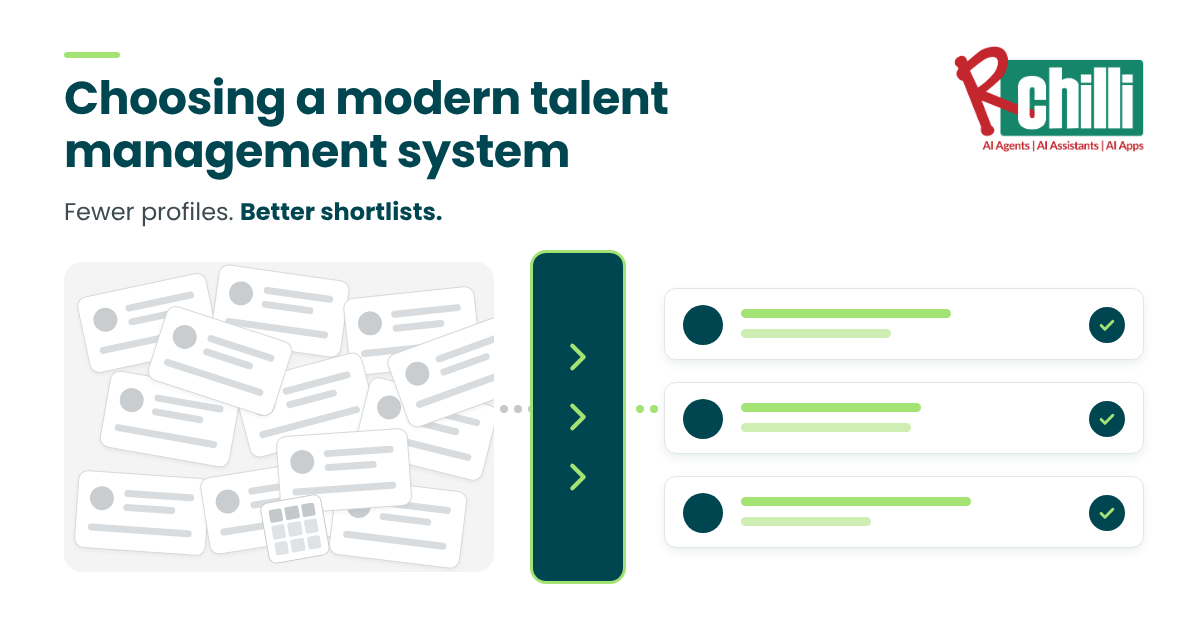
Picture an enterprise HR team managing 8,000 applicants across three business units. Recruiters are copying candidate data from Workday into spreadsheets. Hiring managers are waiting three days for a shortlist that arrives with 40 profiles when they asked for ten strong ones. And somewhere in that pile, the right candidate is probably there, buried under the noise of manual processes that were never designed for this volume.
A modern talent management system solves this problem, but only if you choose the right one for your environment. Buying a basic applicant tracking system and calling it a TMS, or selecting a platform without certified integrations for your ERP, leaves most of the problem intact. This article gives you a clear definition of what a proper TMS covers, the benefits you should be measuring, and a six-question checklist to pressure-test any vendor before you commit.
RChilli, which provides AI-powered recruitment automation for Oracle HCM, SAP SuccessFactors, Workday, and Salesforce environments, is referenced throughout as a practical example of what enterprise-grade capability looks like in production.
What a modern talent management system actually covers
How TMS differs from HRIS, HCM and an ATS
Most procurement conversations stall because these four terms get conflated. An HRIS stores employee records; an HCM manages the full workforce lifecycle administratively, covering payroll, benefits, and time management alongside core HR. An applicant tracking system (ATS) moves candidates through hiring pipelines. A talent management system goes further: it connects hiring decisions to performance outcomes, learning progress, and succession readiness, functioning, in effect, as employee lifecycle management software that spans from first application to eventual transition.
The distinction matters commercially. Buying an ATS and calling it a TMS leaves performance management, learning and development, and succession planning entirely unaddressed. You solve the pipeline problem but not the retention or capability problem, which is where enterprise HR teams typically lose the most value.
The five core modules every enterprise TMS needs
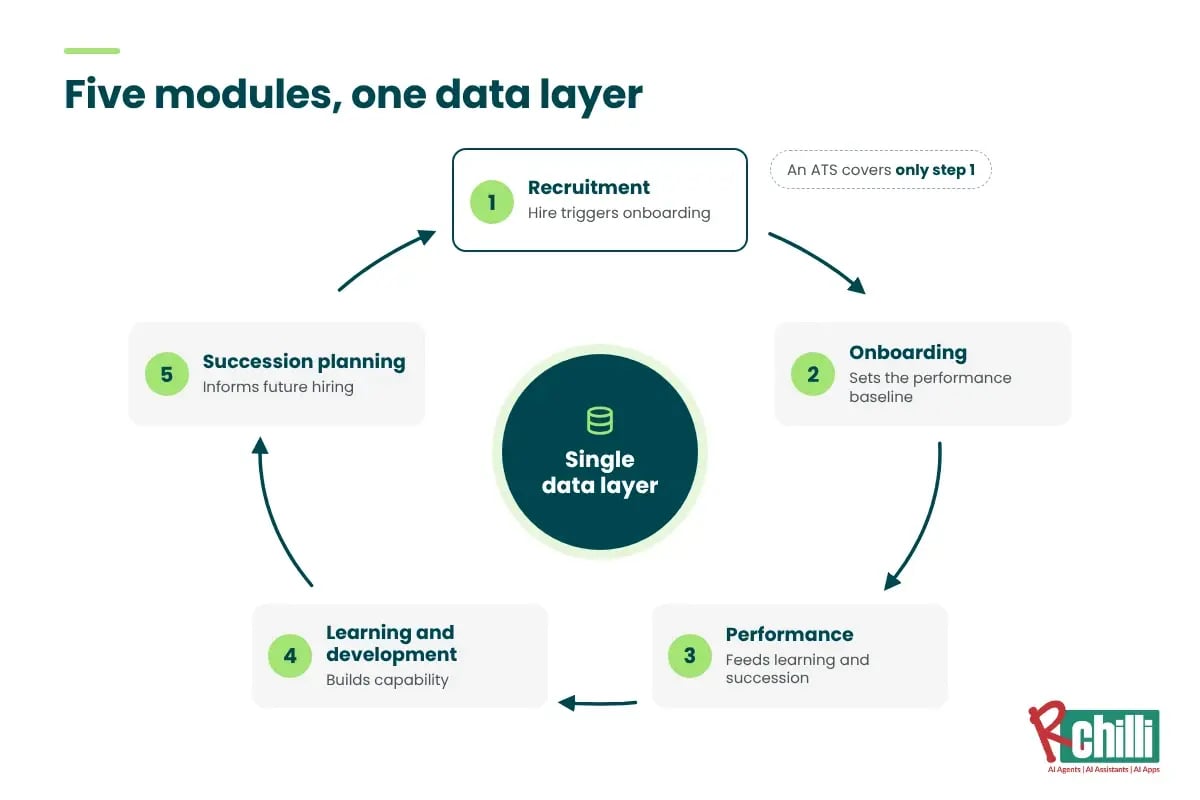
A properly scoped talent management platform covers recruitment, onboarding, performance management, learning and development, and succession planning as a connected whole, not five separate tools. Think of it as succession planning software, performance management, and talent acquisition and retention software operating from a single data layer rather than independent systems.
Data flows between these modules automatically: a completed hire triggers onboarding tasks; onboarding feeds the performance baseline; performance data informs succession decisions. For enterprise HR teams running at volume, these connections must be automated. Manual handoffs between modules simply replicate the spreadsheet problem inside an expensive platform.
Why enterprises need AI-driven automation to scale talent acquisition
Where manual processes break down at volume
At 10,000 applicants a month, no recruiter team can screen consistently. Eye-tracking and time-motion studies in recruitment contexts suggest that initial resume reviews are often very short, a matter of seconds, which means shortlists are built on pattern recognition and fatigue rather than defined criteria. Unconscious bias compounds with every hour of screening. The hiring manager receives 40 profiles because the recruiter wasn’t sure, the role stays open longer, and productivity suffers on both sides of the process.
The measurable ROI organisations are already seeing
The business case for AI-driven talent acquisition is well established in 2026. Enterprises using full-funnel automation are reporting 31% faster time-to-offer, 52% reduction in time-to-interview, and roughly 40% lower time-to-productivity for onboarded employees. Cost-per-hire reductions average around 30%, with mature programmes reporting approximately $2,800 saved per position. These figures reflect industry ranges drawn from published implementation benchmarks; your own results will vary depending on baseline processes, hiring volume, and adoption rates.
Use these figures to establish what good looks like before you start evaluating vendors, not as guaranteed outcomes once you sign a contract.
Integration requirements for Oracle, SAP and Workday users
Why certified connectors matter more than open APIs
Any vendor can promise an API connection. The real question is whether the connector is certified for the specific version of Oracle HCM, SAP SuccessFactors, or Workday you actually run. Uncertified integrations can break silently after platform updates, both Workday and SuccessFactors operate on regular release cycles, and API version changes are a documented risk for non-certified connectors. A properly certified integration includes bi-directional data sync, SSO via SAML or OIDC, SCIM-based provisioning, and sandbox testing environments.
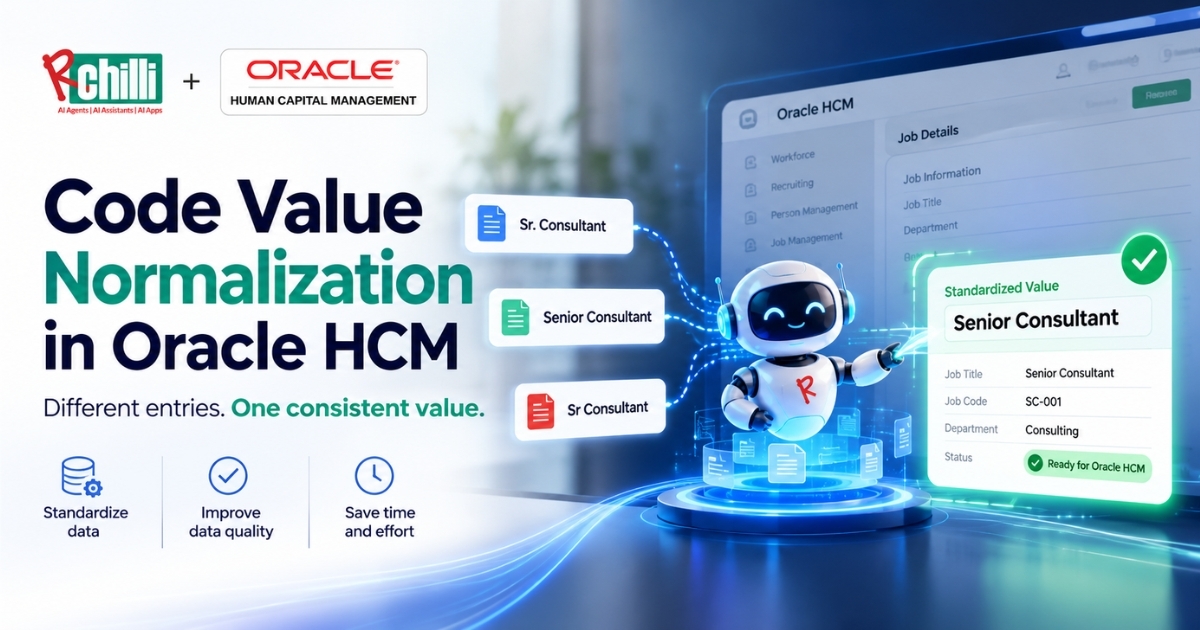
RChilli maintains certified integrations with Oracle HCM, SAP SuccessFactors, Workday, and Salesforce, connectors that are built and maintained to the technical, security, and compatibility requirements each platform vendor publishes. Prospective customers should request certification documentation and validate scope against their specific platform version during procurement. That verification is the difference between a day-one integration that works and one that requires your IT team to patch it every quarter.
Data security non-negotiables: SOC2, GDPR and Indian compliance
SOC2 Type II and GDPR compliance are table stakes for any enterprise handling cross-border candidate data. For Indian organisations, you also need clarity on data residency requirements and how the vendor handles right-to-erasure requests under the Digital Personal Data Protection Act, 2023. When evaluating vendors, ask for their most recent SOC2 Type II audit report, not the marketing badge on their homepage. The full report matters because it documents the audit period, scope, any exceptions noted, and the controls covered; a badge alone tells you nothing about depth or recency.
Check whether the candidate-management environment is in scope, whether privacy and confidentiality criteria were included in the audit, and what the subprocessor data-location details look like. SOC2 is strong evidence of consistent controls, but it is not a substitute for an India-specific data-processing agreement that addresses your legal obligations as a data fiduciary.
Non-negotiable talent management system features for fair and accurate hiring
Bias-free shortlisting and anonymised candidate evaluation
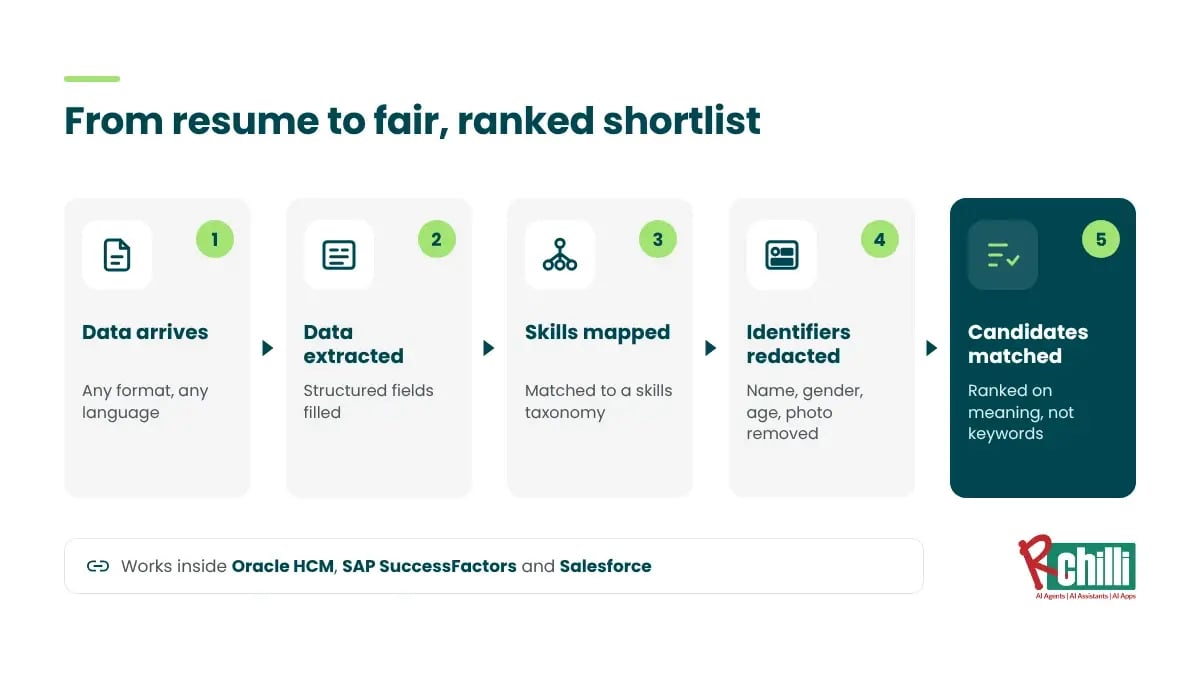
Performance data only improves decisions if the pipeline feeding it is fair. Bias introduced at the screening stage compounds over years into workforce homogeneity and measurable DEI failures. Anonymised screening means redacting name, gender, age, photo, and educational institution before any recruiter sees the profile, so candidates are evaluated on skills and demonstrated capability alone.
For enterprise HR teams with active diversity commitments, account-level configurability of redaction rules is a widely recommended procurement criterion, endorsed by ethical-AI guidance and increasingly reflected in organisational audit requirements. Vendors who cannot configure redaction at an account level fall short of what DEI-focused programmes typically require, and that should be treated as a disqualifying gap during evaluation rather than a minor feature gap to revisit later.
Resume parsing accuracy and job matching speed
Even the best human capital management (HCM) platform produces poor outcomes if the data going into it is inaccurate. Poor resume parsing means structured fields are wrong, skills are missed, and matching produces irrelevant shortlists. High-accuracy parsing covers extraction, standardisation, enrichment, and skills taxonomy mapping across varied document formats and languages.
AI-based job matching evaluates semantic meaning rather than exact keywords. “Managed cross-functional deployment teams” maps to project management experience even when the precise phrase isn’t present. Based on vendor benchmark data and published industry comparisons, AI-powered matching systems report accuracy rates in the range of 78 to 88%, compared to roughly 60 to 70% for keyword-only ATS screening. That gap translates directly into better shortlists and fewer wasted interviews at high candidate volumes, which connects directly to the ROI benchmarks covered earlier.
How RChilli strengthens any enterprise TMS deployment
Custom AI agents and certified integrations built for enterprise HR
RChilli is an AI-powered recruitment automation partner with over 25 years of experience and more than 950 enterprise customers globally (figures from RChilli’s published company information). Its integrations with Oracle HCM, SAP SuccessFactors, Workday, and Salesforce are designed to address the capabilities that matter most in a talent management software context: AI-powered resume parsing that eliminates manual data entry across millions of candidate records, bias-redaction that removes personal identifiers before screening, and job matching that has delivered accuracy improvements of up to 45% in documented customer deployments, though individual results will vary based on baseline data quality, role complexity, and configuration.
The platform is SOC2 and GDPR compliant, supports custom AI agent development for specific recruiting workflows such as job description enrichment and candidate scoring, and is designed to sit within existing ERP environments without requiring infrastructure changes. For enterprise HR teams already invested in Oracle, SAP, or Workday, that matters enormously. You are not rebuilding your stack; you are making the one you have work significantly harder.
A real enterprise result: less manual work, better shortlists
An enterprise HR team managing high-volume hiring across multiple geographies integrated RChilli with their existing SAP SuccessFactors environment. According to RChilli’s vendor case study, recruiters had previously been spending 60 to 70% of their time on manual data entry and initial screening. After deploying RChilli’s AI agents, that allocation dropped by more than half, recruiter focus shifted to qualified shortlists, and job matching accuracy improved by over 40% within three months. These figures are drawn from the vendor’s own reporting and should be validated with RChilli directly, including methodology and measurement approach, during your evaluation.
The integration required minimal disruption to existing ERP workflows because RChilli’s connector was already built for their platform version, there was no re-implementation of SAP, no data migration project, and no IT escalation reported. As with any enterprise integration, some configuration and testing will typically be required; the degree of complexity depends on your specific environment and customisations.
A practical checklist to evaluate and shortlist your TMS vendor
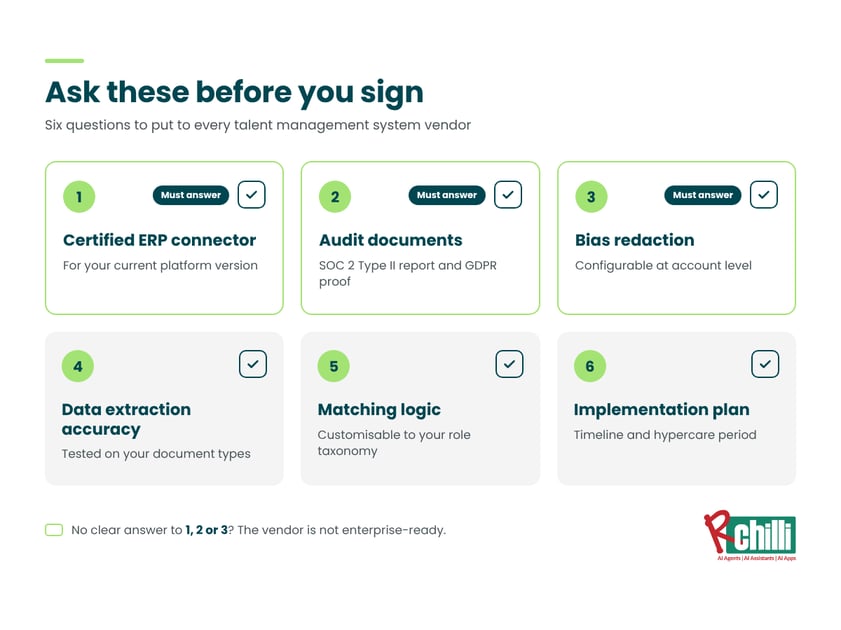
Six questions to answer before you sign a contract
Run every vendor through these six questions before you reach the demo stage. If they cannot answer clearly and with supporting documentation, such as audit reports, integration certificates, and SLA terms, treat that as a signal they are not ready for enterprise deployment.
- Does the vendor have a certified, maintained connector for your ERP (Oracle HCM, SAP SuccessFactors, or Workday) that supports your current platform version?
- Can the vendor provide their SOC2 Type II audit report and GDPR compliance documentation on request?
- Does the system support anonymised candidate screening with configurable bias-redaction rules?
- What is the resume parsing accuracy rate, and how is it measured against your specific document types and languages?
- How does the job matching engine score and rank candidates, and can the model be customised for your role taxonomies?
- What does the implementation timeline and hypercare period look like for an enterprise of your size and integration complexity?
Matching vendor capabilities to your organisation’s pain points
Before you score vendors, identify your top bottlenecks from this list: manual screening volume, integration fragility with your current ERP, bias in shortlisting, slow time-to-fill, or poor quality-of-hire. Then map each bottleneck directly to the six questions above. A vendor who cannot answer questions 1, 2, and 3 clearly is not enterprise-ready, regardless of how their marketing positions them.
This exercise converts a feature comparison into a buying-decision filter. You stop comparing slide decks and start comparing operational readiness. That shift alone will eliminate most vendors from serious consideration within the first meeting.
The right system removes the trade-off
The enterprise HR team in the opening scenario does not have to choose between speed and accuracy. Choosing the right talent management system removes that trade-off by eliminating the manual steps that create it in the first place. Recruiters redirect their time from data entry to qualified shortlists. Hiring managers receive ten strong profiles rather than forty uncertain ones, and candidates move through a faster, fairer process, outcomes that compound over every hiring cycle.
You now have a clear picture of what a modern talent management system covers and how it differs from an ATS, HRIS, or HCM; a shortlist of non-negotiable features and integration requirements; and six concrete questions to pressure-test any vendor. Apply them in sequence, before you reach the demo stage, and they will do most of the filtering work for you.
The organisations reporting 30 to 50% reductions in time-to-fill are not running better recruiters, they are running smarter systems. If your environment is built on Oracle HCM, SAP SuccessFactors, or Workday, exploring RChilli’s certified integrations with your platform team is a practical starting point. The RChilli team can map their connectors directly to your current stack and walk you through the compliance and configuration detail that matters for your specific deployment.


Leave a Reply