
by Lovepreet Singh
Every Oracle HCM Recruiting Cloud tenant accumulates data from hundreds of sources: resumes, career sites, job boards, agency submissions, and internal referrals. When those records use inconsistent codes for job titles, skills, and locations, your searches return incomplete results and your reports tell conflicting stories.
Code value normalization solves that problem by aligning every entry to a controlled, standardized set of values.
This article explains what code value normalization means inside Oracle HCM, how lookups and value sets enforce it, and why it matters for recruiting data quality. You will also see how RChilli helps Oracle HCM customers automate the normalization process at scale.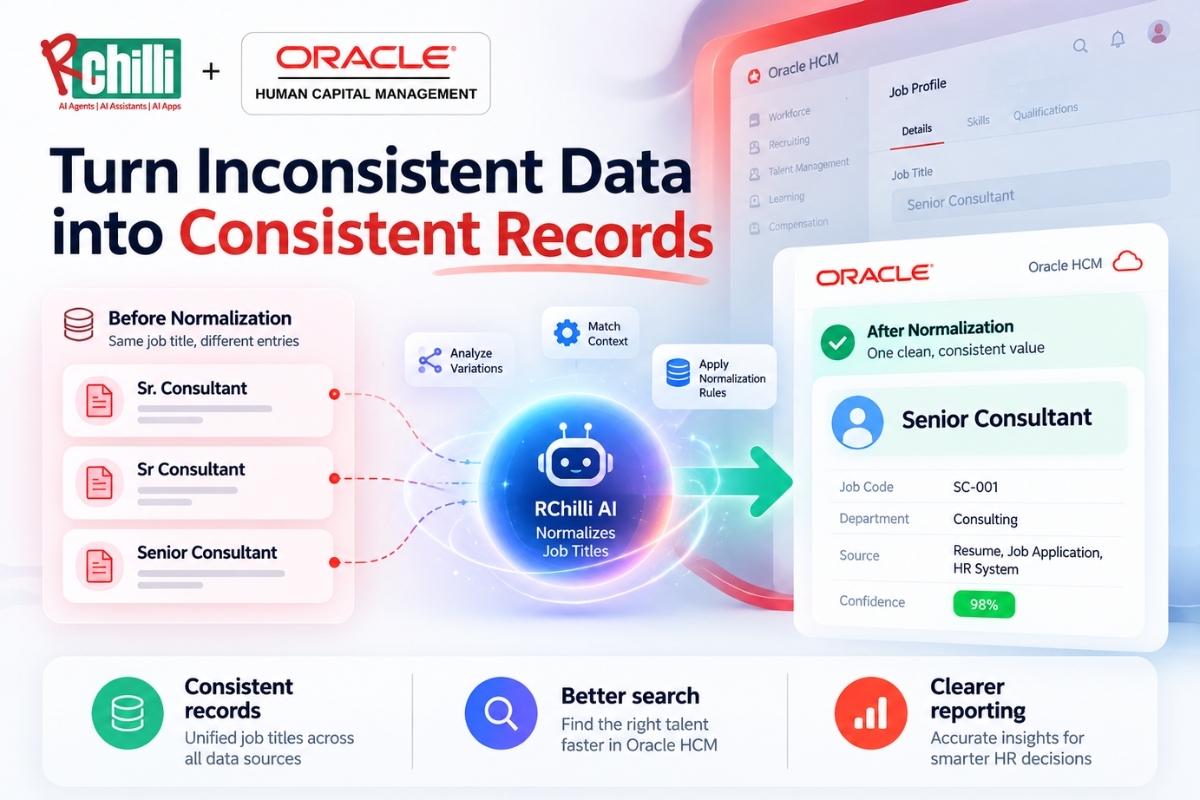
Key Takeaways: Code Value Normalization in Oracle HCM
- Code value normalization maps inconsistent data entries to a single approved value in Oracle HCM.
- Oracle uses lookups and value sets to restrict field inputs and maintain consistent recruiting records.
- Normalized data improves candidate search accuracy, reporting reliability, and compliance readiness.
- RChilli's List of Values (LOV) solution automates value mapping for Oracle HCM recruiting tenants.
- Regular reprocessing of your candidate database keeps normalized values current as taxonomies evolve.
What Is Code Value Normalization in Oracle HCM?
Code value normalization is the process of converting free-text or inconsistent field entries into predefined, standardized codes. In Oracle HCM, this applies to any field that accepts candidate or employee data: job titles, skill names, degree types, location codes, and employment categories.
Oracle enforces normalization through two primary mechanisms: lookups and value sets. Lookups are predefined lists of values (such as "Full-Time," "Part-Time," and "Contract") attached to specific fields. Value sets define the valid format and content rules for flexfield segments and report parameters.
Together, these tools ensure that when a recruiter or an automated import creates a candidate profile, the data stored in Oracle follows a single, consistent structure.
Why Does Normalized Data Matter for Oracle HCM Recruiting?
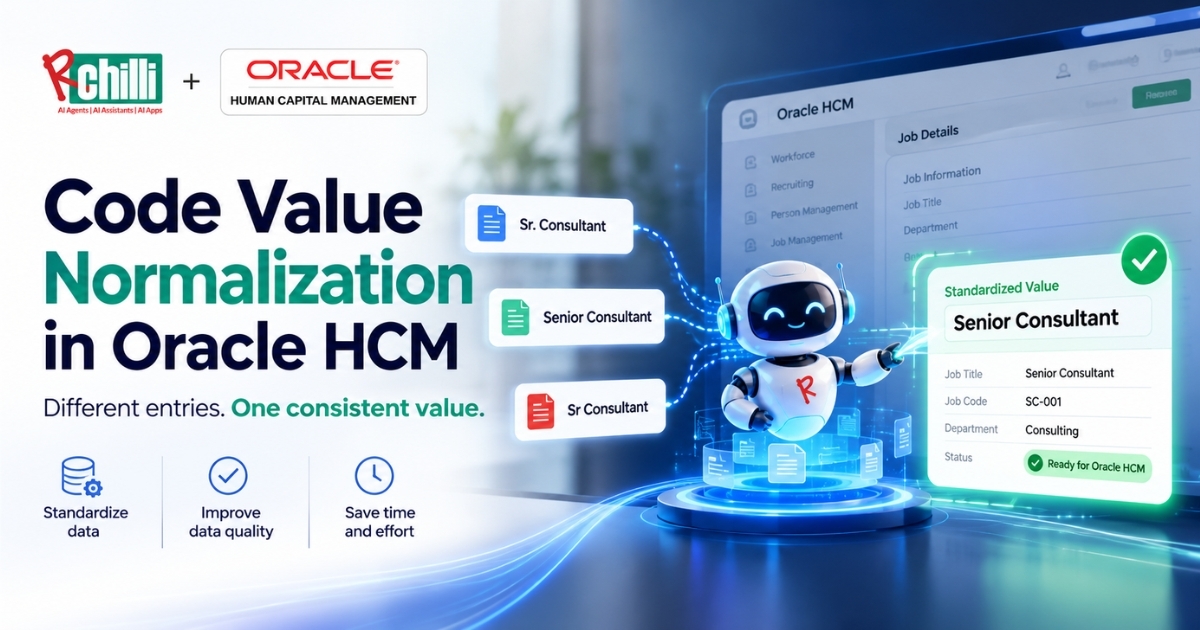
Without normalization, the same piece of information gets recorded in dozens of ways. A single job title might appear as "Sr. Consultant," "Senior Consultant," "Sr Consultant," or "Snr. Consultant" across different candidate profiles. Each variation looks unique to Oracle's search engine, so a recruiter searching for "Senior Consultant" misses every alternate spelling.
That fragmentation compounds across your entire tenant. According to a 2025 Forbes HR Council analysis, AI tools built on flawed candidate data produce poor hiring outcomes because the underlying records lack structure and consistency.
Normalized data directly addresses this gap. It sharpens candidate search results, generates reliable analytics, and gives you the clean foundation AI-driven matching needs to work correctly.
How Do Lookups Work for Value Standardization in Oracle HCM?
Lookups in Oracle HCM are controlled lists of values tied to specific application fields. Oracle ships predefined lookup types for common recruiting fields like assignment category (EMP_CAT), gender, and nationality.
There are three lookup categories. Standard lookups are system-managed and cannot be modified. Common lookups allow administrators to add new values or enable and disable existing ones. Set-enabled lookups restrict values based on business unit or legislative context.
For recruiting data, common lookups are the most relevant. Your Oracle administrator can add organization-specific values (such as custom job categories or requisition types) and tag them for specific legislations.
This means the same lookup type can display different valid values for your UK hiring team and your US hiring team.
What Role Do Value Sets Play in Oracle HCM Data Hygiene?
Value sets go beyond lookups by controlling the format, data type, and source of valid entries for flexfield segments and report parameters. Oracle Fusion HCM supports five value set types: Independent, Dependent, Table, Translatable Independent, and Format Only.
Independent value sets contain a static list of approved codes. Dependent value sets change their available options based on a parent selection (for example, showing only valid cities after a country is chosen). Table value sets pull values dynamically from a database table, keeping options current without manual updates.
For recruiting, value sets are commonly attached to Descriptive Flexfields (DFFs) that capture custom candidate attributes like visa type, security clearance level, or project code. By linking these flexfields to a value set, you prevent free-text entry and guarantee every candidate record uses the same controlled vocabulary.
How RChilli Automates Code Value Normalization in Oracle HCM
Configuring lookups and value sets handles the validation layer. But what happens to the thousands of candidate records that already exist in your tenant with unstandardized data? And how do you normalize incoming resumes parsed from dozens of formats and languages?
RChilli's Oracle HCM integration addresses both challenges. The List of Values (LOV) solution maps parsed resume data to your Oracle picklists automatically. When RChilli's Resume Parser extracts a job title like "Sr. Cons." from a candidate's resume, LOV maps it to the approved Oracle value "Senior Consultant" before the profile is created.
For existing records, RChilli's Data Hygiene tools reprocess your entire candidate database. The process retrieves stored resumes, parses them with the latest extraction logic, and updates over 100 fields, including both standard and custom attributes, to match your current taxonomy and value set definitions.
Where Does Taxonomy Fit into Value Normalization?
Taxonomy sits one layer above individual lookups and value sets. It defines the master classification structure for skills, job titles, education levels, and locations across your organization.
RChilli Taxonomy draws from a library of over 3 million skills and 2.4 million job profiles across 36 languages. When a candidate submits a resume listing "PM" as a skill, the taxonomy resolves whether that means "Project Management" or "Product Management" based on context.
It then maps the value to the correct standardized code in your Oracle tenant.
This contextual resolution is what separates taxonomy-driven normalization from simple string matching. It ensures your Oracle HCM tenant stores meaningful, searchable data rather than ambiguous abbreviations. You can learn more about this capability on RChilli's Taxonomy page.
What Are Common Code Normalization Challenges in Oracle HCM?
Inconsistent Legacy Data from Migrations
When organizations migrate candidate data from a legacy ATS to Oracle Recruiting Cloud, historical records often carry non-standard codes and free-text values that do not align with Oracle's lookup structure. Running a full database reprocessing pass after migration catches these inconsistencies before they pollute your search results.
Multilingual Resume Inputs
Global hiring means resumes arrive in dozens of languages. A skill labeled "Gestion de projet" needs to map to the same normalized code as "Project Management." RChilli's multilingual parsing handles this by extracting data in 40+ languages and aligning it to a unified taxonomy before it enters Oracle.
Drift Between Taxonomy Versions
Skills and job titles evolve. A role that did not exist two years ago (like "Prompt Engineer") needs to be added to your taxonomy and value sets. Scheduling periodic data reprocessing ensures your existing records stay aligned with the latest classification standards.
How to Build a Code Value Normalization Strategy for Oracle HCM
Start by auditing your current Oracle lookup types and value sets. Identify fields where free-text entry is still allowed and where multiple codes represent the same concept. Oracle's Manage Common Lookups and Manage Value Sets tasks under Setup and Maintenance give you full visibility into your current configuration.
Next, standardize your resume intake pipeline. Ensure every resume entering Oracle, whether through a career site, email, job board, or bulk import, passes through a parsing and normalization layer before profile creation. RChilli's Enhanced Candidate Profile Import (CPI) does this automatically for Oracle Recruiting Cloud.
Finally, establish a reprocessing cadence for your existing database. Quarterly or biannual reprocessing keeps your candidate records accurate and aligned with evolving taxonomy standards. This is especially important before launching analytics, AI matching, or workforce planning initiatives that depend on clean data.
In Conclusion: Clean Oracle HCM Data Starts with Normalization
Code value normalization is the foundation of trustworthy recruiting data in Oracle HCM. It ensures every candidate record follows the same structure, every search returns complete results, and every report tells an accurate story.
Oracle's built-in lookups and value sets handle the validation rules. RChilli extends that foundation with automated LOV mapping, taxonomy-driven standardization across 3 million+ skills, and full database reprocessing.
We have been building recruiting automation for Oracle HCM since 2010, and data quality has always been central to that mission.
Ready to see how normalized data changes your Oracle recruiting outcomes? Let's talk.
FAQs About Code Value Normalization in Oracle HCM
What is the difference between a lookup and a value set in Oracle HCM?
A lookup is a predefined list of values tied directly to an application field, while a value set controls the format, data type, and validation rules for flexfield segments. Both enforce standardized data entry in Oracle HCM.
Lookups work for standard fields. Value sets are used with Descriptive Flexfields and Extensible Flexfields for custom attributes.
Can code value normalization be applied retroactively to existing Oracle HCM data?
Yes. RChilli's Full Database Reprocessing retrieves stored resumes from your Oracle tenant, parses them with updated logic, and refreshes over 100 fields to match your current taxonomy and value standards. You control how frequently the reprocessing runs.
How does RChilli's LOV solution work with Oracle HCM picklists?
RChilli's List of Values (LOV) maps parsed resume data to your Oracle picklist values automatically. When the RChilli Resume Parser extracts a skill or job title, LOV matches it against your configured Oracle lookups and inserts the standardized code into the candidate profile.
Does normalization support multilingual recruiting in Oracle HCM?
Yes. RChilli parses resumes in 40+ languages and maps extracted values to a unified taxonomy. This means a skill recorded in French, German, or Japanese resolves to the same normalized code in your Oracle HCM tenant, making cross-region search and reporting consistent.
How often should you reprocess Oracle HCM candidate data for normalization?
Most organizations benefit from quarterly reprocessing. If your taxonomy or lookup configurations change frequently, or if you are preparing for a major analytics initiative, more frequent reprocessing may be necessary. RChilli's data hygiene tools let you set custom schedules based on your team's needs.


Leave a Reply