by Lovepreet Singh
Oracle Fusion Cloud HCM gives enterprise HR teams a solid recruiting foundation: job requisitions, candidate management, interview scheduling, offers, and hiring analytics all in one place. As hiring volume grows, some workflows can show friction in three places, resume data entry, candidate screening, and accurate matching, particularly in high-volume enterprise environments. That's where the difference between standard Oracle HCM Cloud recruiting and AI-enhanced recruiting becomes clear. This article walks through what Oracle Cloud HCM handles natively, where friction can develop under volume pressure, and what actually changes when you integrate an AI layer like RChilli into the mix.
The honest answer isn't that Oracle Human Capital Management Cloud is broken. It isn't. It was built to be a system of record and workflow engine, not a document interpretation machine. Understanding that distinction is what makes the difference between a recruiting operation that scales and one that bends under its own weight.
Key takeaways
- Oracle HCM recruiting is comprehensive: It handles the full recruiting workflow from requisition to hire and connects directly into onboarding, payroll, and analytics on a shared data model.
- High volume can expose a gap: Manual resume data entry has been estimated at 10 to 15 hours per recruiter per week in some enterprise environments, and inconsistent screening compounds the problem.
- AI changes the starting point: With automated parsing integrated into Oracle Cloud HCM, incoming resumes can be extracted and structured earlier in the process, reducing the data-entry burden on recruiters.
- Bias reduction can become structural: RChilli's redaction capability removes personal identifiers inside the Oracle workflow, making blind screening a process outcome rather than a separate audit step.
What Oracle HCM Cloud recruiting handles on its own
The recruiting module inside Oracle Fusion Cloud HCM covers the structural workflow of hiring: job requisitions, candidate sourcing, applicant tracking, interview coordination, offer management, and hiring completion. These capabilities sit within a unified platform that shares employee data across HR, payroll, compensation, and talent management, reducing duplicate entry and disconnected handoffs downstream. That continuity is a genuine strength of Oracle Human Capital Management Cloud compared to point solutions that handle only a slice of the process.
What makes this more valuable than it might sound is the shared data model. Recruiting feeds directly into onboarding, core HR, benefits enrollment, and workforce analytics without manual handoffs between systems. For enterprise HR teams who need visibility across the full hire-to-retire lifecycle, not just the front end of recruiting, that continuity matters enormously. Under most standard hiring configurations, a completed hire in Oracle Recruiting translates quickly into a worker record in Oracle Core HR.
Oracle also embeds generative AI and AI agents across its suite, including within recruiting. In practice, this shows up as candidate recommendations, job description drafting assistance, and AI matching ratings that score applications from 0 to 5 across education, experience, skills, and profile. It's genuinely useful. For some organizations, though, the depth of automated resume parsing and candidate matching needed in high-volume hiring may exceed what the native AI layer provides. That's not a criticism of Oracle; it's an honest description of where native capabilities and specialized tools serve different purposes.
Why high-volume hiring strains even a system this robust
When large volumes of resumes arrive, someone or something has to extract, standardize, and enter that data into the system. Without dedicated parsing automation, recruiters can spend significant time on manual data entry, introducing errors and slowing down screening. One implementation analysis estimated this at 10 to 15 hours per recruiter per week in some enterprise environments. Even with a robust platform in place, this step can remain a manual drag on the entire pipeline.
The problem with manual screening isn't only time. Human reviewers apply different standards across a large candidate pool, especially when fatigued. Inconsistent skills labels create poor search results: "project management," "PM," and "Project Mgr" may all describe the same competency, but a keyword search treats them as separate entries. Some qualified candidates get overlooked while others advance based on incomplete evaluation. That's a structural problem the standard Oracle HCM interface doesn't fully resolve on its own.
Matching a candidate to a job requirement sounds simple until you're doing it across hundreds of open roles and thousands of profiles simultaneously. Oracle does offer native AI matching and suggested-candidate features that go beyond exact keyword searches, but manual review can remain a bottleneck for teams without additional automation. The result of unaddressed bottlenecks is a longer time-to-fill and a higher risk of poor hires. Oracle's recruiting documentation cites fragmented tools and siloed hiring data as contributors to longer recruiting workflows and reduced hiring visibility.
What actually changes when AI is layered into Oracle HCM recruiting
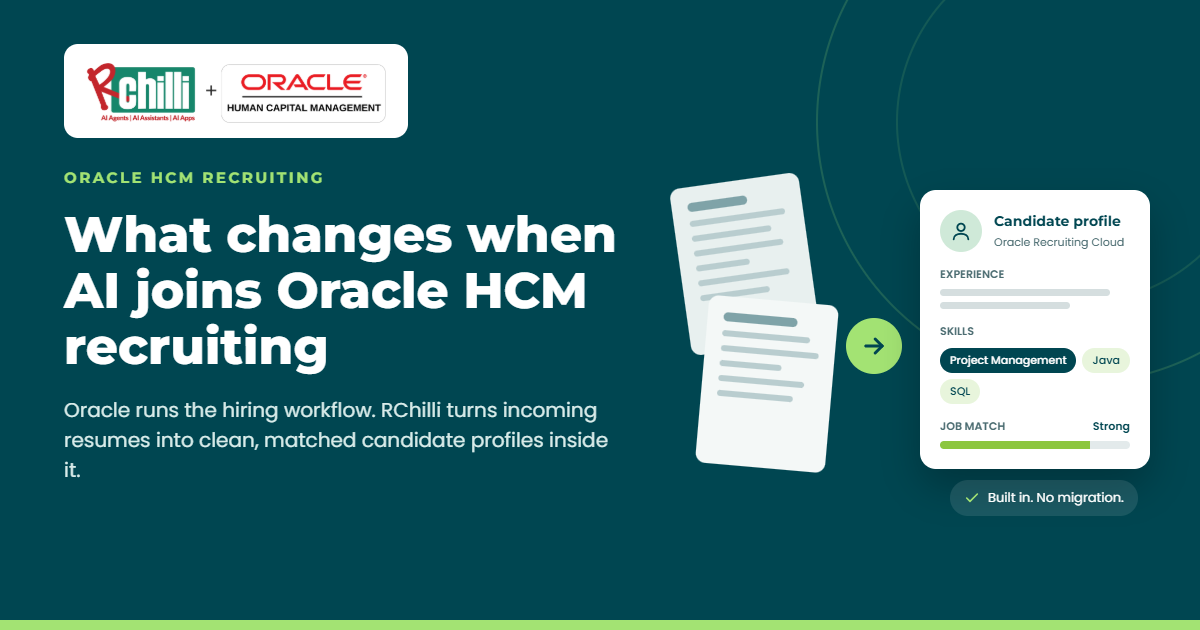
When AI-powered resume parsing is integrated into Oracle Cloud HCM, incoming resumes can be automatically extracted, structured, and enriched before a recruiter reviews them. The recruiter's job shifts from data input to actual evaluation. Consider how much of a recruiter's day was previously consumed by copying names, employment histories, certifications, and education records field by field into Oracle, that's the work that parsing automation is designed to eliminate.
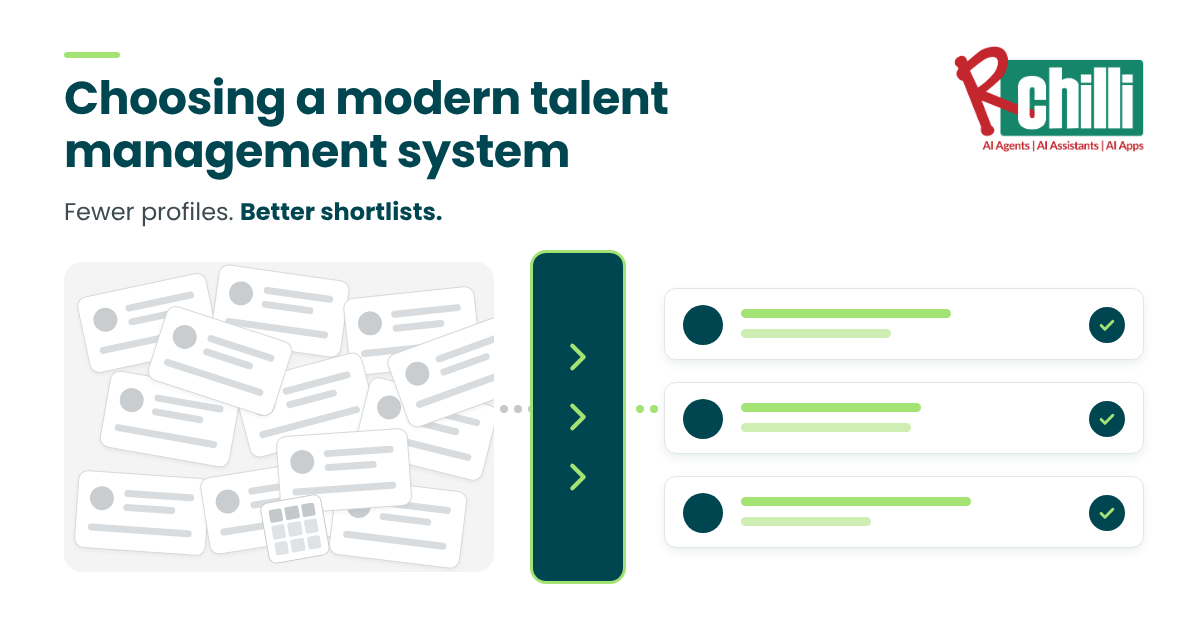
AI matching engines can score candidates against job requirements quickly, surfacing the most relevant profiles at the top of the queue. This changes the recruiter's workflow from search-and-sort to review-and-decide. With a tool like RChilli integrated directly into Oracle HCM, that matching happens inside the system the recruiter already works in. The recruiter isn't toggling between tools; they're working in Oracle with better information already organized for them.
When AI redacts personal identifiers and evaluates candidates on skills and demonstrated capability, DEI goals move from aspirational to operational. Rather than a separate audit step layered on after the fact, redaction becomes a configurable part of how profiles are processed. Organizations using Oracle HCM for high-volume hiring can embed fairness into the screening workflow rather than trying to retrofit it after decisions have already been made.
How RChilli extends Oracle HCM Cloud recruiting without disrupting it
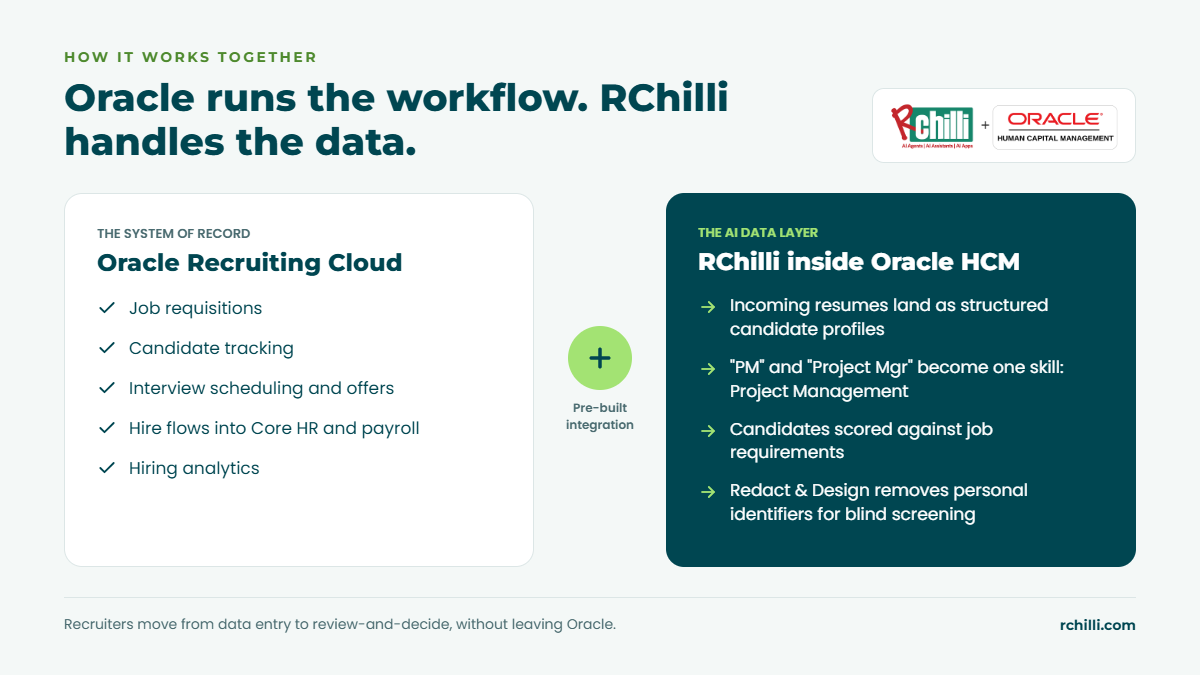
RChilli integrates with Oracle HCM Cloud via a pre-built Oracle integration, meaning it operates within the existing Oracle environment rather than requiring a parallel system. Resume data flows through RChilli's AI parsing engine and lands in Oracle as a clean, enriched candidate profile. For HR teams that have invested in Oracle Human Capital Management Cloud, this matters: there's no migration, no ripping and replacing, and no disruption to existing workflows.
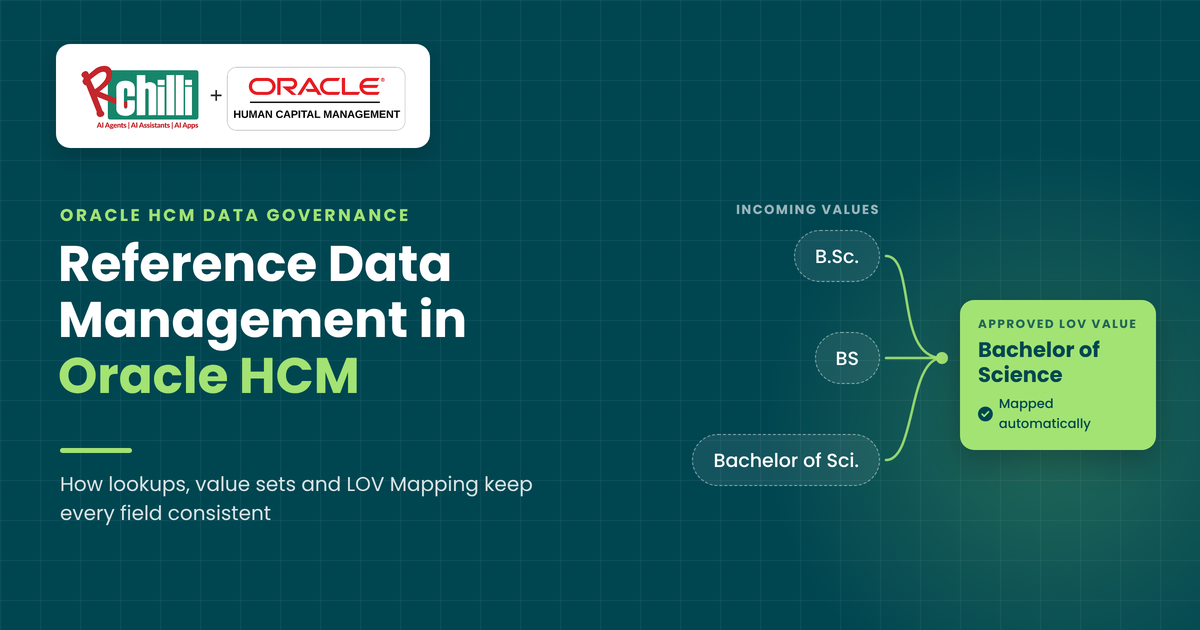
RChilli integrates with Oracle HCM to process resume data. RChilli's parser extracts, standardizes, and enriches resume data. That standardization can help reduce the inconsistent-label problem, where "PM" and "Project Mgr" are treated as different entries, at the source.
RChilli integrates with Oracle HCM and redacts personal identifiers for bias-free screening. The result is a consistent, standardized profile that presents candidates through skills, qualifications, and experience rather than personal characteristics.
RChilli maintains SOC 2 and GDPR compliance, which matters for enterprise HR teams operating under strict data governance requirements. When evaluating any AI tool for integration with Oracle HCM, compliance can't be an afterthought. RChilli has over 25 years of experience and more than 950 customers.
What HR leaders should evaluate before integrating AI recruiting tools
Not every AI recruiting tool integrates equally with Oracle HCM. Some connect via generic APIs that require custom maintenance; others use purpose-built Oracle-certified connectors. HR leaders should ask how the data flows, who maintains the connection when Oracle updates its environment, and whether the integration requires ongoing developer support or runs out of the box. Surface-level connectivity that breaks during Oracle updates is a risk worth evaluating carefully, it can create more work than it saves.
ROI on AI-enhanced recruiting isn't just about speed. It includes data accuracy rates, reduction in recruiter hours spent on manual tasks, improvement in candidate-to-offer ratios, and DEI screening consistency. Before integrating any tool into Oracle HCM modules, establish baseline metrics on those dimensions so the impact is measurable, not assumed. The organizations that get the most out of AI recruiting tools are the ones that knew what they were measuring before they turned the tool on.
It's also worth asking whether the AI layer you're evaluating is genuinely designed for high-volume recruiting or simply claims to be. High-volume hiring creates specific pressures: resume format variability, skills taxonomy inconsistency, duplicate record management, and the need to process bulk uploads without degrading data quality. Those pressures don't show up in a demo with ten sample resumes; they show up at scale. That's exactly the environment RChilli was built for.
The honest answer to what changes
Oracle HCM Cloud is a serious enterprise platform, and its recruiting module handles the structural work of hiring well. High-volume recruiting can expose gaps that native tools alone don't fully close: the manual, error-prone work of processing, screening, and matching thousands of candidates. When AI is integrated thoughtfully, that gap can narrow significantly. Resume data entry becomes a smaller burden. Matching moves beyond keyword searches. Screening becomes more consistent across the full candidate pool.
RChilli's integration with Oracle HCM Cloud represents exactly this kind of change: not a replacement, but an extension that makes the existing system more capable where volume and data complexity put it under pressure. The recruiting module you've already deployed handles the workflow. RChilli handles the data. Together, the system behaves differently at scale than it does running natively, and that difference can show up in recruiter hours recovered, candidate quality, and the consistency of your screening process.
If your team is managing high-volume hiring inside Oracle HCM and you're watching recruiters spend hours on data entry before they can even begin evaluating candidates, that's the problem worth solving before your next hiring cycle. Reach out to our team to see how RChilli's Oracle integration works in practice for organizations at your scale.
Frequently Asked Questions
Does Oracle HCM already have AI recruiting features?
Yes, Oracle HCM includes AI recruiting features such as candidate recommendations, job description drafting assistance, and matching ratings. Your team may still need more specialized parsing and matching for high-volume hiring.
Will we need to replace Oracle HCM to use RChilli?
No, you can use RChilli within your existing Oracle HCM environment through a pre-built integration. Resume data is processed into enriched candidate profiles without migrating or replacing your recruiting system.
How can we measure the impact of AI-enhanced recruiting?
You can measure impact using data accuracy, recruiter hours spent on manual tasks, candidate-to-offer ratios, and screening consistency. Establish baseline metrics before integration so your team can measure changes afterward.
How does resume redaction support fairer screening?
Resume redaction removes personal identifiers so your team can screen candidates based on skills, qualifications, and experience. In Oracle HCM, redaction can be a configurable part of profile processing rather than a separate audit step.


Leave a Reply