

by Amruta Singh
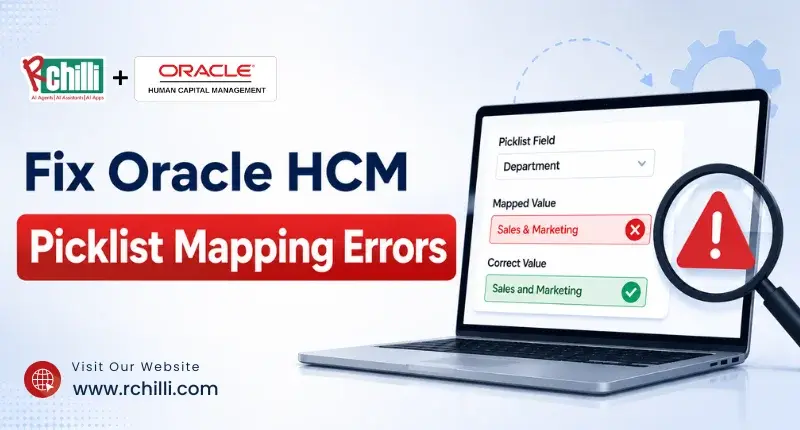
A recruiter opens three candidate profiles for the same role. One lists "MBA." Another says "M.B.A." A third spells it out: "Master of Business Administration." Same degree, three different values in the system — and now the filter that was supposed to shortlist qualified candidates in seconds just missed two of them.
That's what inconsistent skills mapping looks like inside Oracle HCM, and it's more common than most talent acquisition teams admit out loud.
The situation: free-text data breaks structured systems
Resumes don't arrive in Oracle's format. Candidates write "B.Tech," "Bachelor of Technology," "B. Tech.," and "Bachelors in Technology" for the same credential. Job titles, skills, and locations show the same drift. Oracle Cloud HCM expects clean, system-defined values — but resume data comes in however the candidate happened to type it.
The result shows up everywhere a recruiter touches the system: filters return incomplete candidate pools, dashboards report numbers that don't match reality, and every mismatch becomes a manual fix somebody has to make by hand.
.webp?width=800&height=430&name=nconsistent%20Skills%20Mapping%20Is%20Costing%20You%20Candidates%20(1).webp)
The industry standard: manual correction, quietly, at scale
Most Oracle HCM teams handle this the way they've always handled it — recruiters or HR ops staff manually retype, reclassify, and reconcile candidate fields one profile at a time. It works, technically. It also eats hours every week, delays screening, and leaves compliance and reporting resting on data nobody's fully confident in.
For regulated roles, that's not just an inconvenience. Inconsistent fields make it harder to prove a hiring process was applied consistently, which is exactly the kind of gap an audit finds.
RChilli's offering: LOV (List of Values) Mapping
RChilli's LOV (List of Values) Mapping solves this at the source. It automatically maps resume data — skills, job titles, locations, industries, education — to Oracle environment-defined values, in real time, validated against Oracle's own business rules.
Here's what changes:
-
Intelligent mapping of resume data to system-defined LOVs.
Skills, titles, locations, industry, and education get matched to the right controlled value automatically, instead of landing as free text. -
Real-time validation against Oracle rules.
Every mapped field is checked against Oracle's validation rules, format checks, and mandatory-field requirements before it lands in the system. -
Standardization across regions, roles, and datasets.
The same degree or skill gets the same value whether it came from a candidate in Chicago or Chennai. -
Integration with resume parsing and data enrichment.
LOV Mapping works alongside Enhanced Candidate Profile Import, so standardized data flows in as part of the same process — not a separate cleanup step afterward.
Configuration is a one-time setup: map the LOVs, activate the data mapping workflow, and it applies across new candidates, bulk imports, and database reprocessing going forward.
The before-and-after is straightforward. Before: "B.Tech," "Bachelor of Technology," "B. Tech.," and "Bachelors in Technology" all sit in the system as different values, and every filter built on top of them misses candidates. After: all four map to one standardized value, so filters, dashboards, and shortlists finally reflect the real candidate pool.
On the numbers: LOV Mapping delivers upto 95% accuracy in mapping candidate data to LOV fields, saves roughly 3–5 minutes per application, and adds up to an estimated 1,600+ recruiter hours saved per month across a typical enterprise Oracle HCM deployment. Oracle HCM teams using RChilli's broader automation layer have also seen upto 89% reduction in manual data entry effort.
That's fewer rejected applications due to formatting mismatches, faster shortlisting, and reporting recruiters can actually trust.
Certifications
RChilli's Oracle HCM solutions are built on enterprise-grade security and compliance: ISO 27001:2022, SOC 2 Type II, GDPR, HIPAA, and PCI.
The bottom line
Your analytics and hiring decisions are only as strong as your data consistency. If your Oracle HCM team is still manually reconciling degree names, job titles, and skills across candidate profiles, that's hours you're not getting back — and candidates you may already be missing.
See how LOV Mapping standardizes your Oracle HCM candidate data — Book a demo.
FAQ
What is List of Values (LOV) in Oracle HCM?
List of Values (LOV) refers to the predefined, system-controlled fields Oracle Cloud HCM uses for data like education, skills, job titles, and location. RChilli's LOV Mapping automatically aligns free-text resume data to these approved values, eliminating inconsistent entries like "MBA" versus "Master of Business Administration."
How does LOV mapping work in Oracle Recruiting Cloud?
RChilli's LOV Mapping intelligently matches extracted resume data — skills, job title, location, industry, and education — to Oracle's system-defined values, then validates each mapped field in real time against Oracle's own business rules, format checks, and mandatory-field requirements before it's saved to the candidate profile.
Why is standardized data mapping important for Oracle HCM reporting?
Reporting and analytics are only as reliable as the underlying data. When the same qualification or skill is stored as multiple different values, dashboards undercount qualified candidates and filters miss strong applicants. Standardized mapping means every report reflects the actual candidate pool, supporting stronger compliance and audit readiness too.
What fields does LOV standardize in Oracle HCM?
LOV Mapping standardizes core candidate data fields including education/degrees, skills, job titles, industry, and location, aligning each to Oracle's approved controlled values across regions, roles, and datasets.
How does LOV reduce data inconsistency in Oracle recruiting?
By automatically mapping resume data to a single standardized value at the point of intake — rather than relying on recruiters to catch and correct mismatches later — LOV Mapping prevents the same degree, title, or skill from ever existing as multiple conflicting entries in the system.


.webp)
Leave a Reply