by Lovepreet Singh
Ask five HR leaders what an AI agent is and you'll get five answers. A chatbot on the careers page. A copilot that drafts emails. A dashboard that predicts attrition. All of those get sold as "AI in HCM," and most of them never touch the work your team does every day.
An AI agent is different. It reads the data in your HCM system, does a specific piece of work, and puts the result back where your team already works, after a person approves it. That last part matters more than the AI itself.
Here's what that looks like in practice, where it works today, and where it doesn't yet.
What AI-driven features do HCM platforms offer today?
Most HCM suites now ship some AI. The features usually fall into five groups:
- Recruiting: job description drafting, application screening, candidate ranking, interview preparation
- Onboarding: document collection, task reminders, answers to new-hire questions
- Employee self-service: chat interfaces for policy, leave and benefits questions
- Talent management: skills inference, learning recommendations, internal mobility suggestions
- Payroll and analytics: anomaly checks, forecasting, report summaries
The catch is depth. Many of these are assistants: they answer a question or suggest a next step, and a person still does the work. Agents do the work, inside the system, with a review step before anything changes.
What's the difference between a chatbot, an assistant and an agent?
The three words get used as if they mean the same thing. They don't.
|
Chatbot |
Assistant (copilot) |
AI agent |
|
|---|---|---|---|
|
What it does |
Answers questions from a script or knowledge base |
Suggests drafts and next steps |
Completes a defined task end to end |
|
Reads HCM data |
Rarely |
Sometimes |
Yes, the records it works on |
|
Changes HCM records |
No |
No, a person copies the output |
Yes, after a person approves |
|
Example |
"What's our leave policy?" |
"Draft a job description for me" |
Scores 300 applications against the requisition and writes the ranking back |
A chatbot saves a phone call. An agent saves the hours behind it.
What role do virtual agents play in HR software?
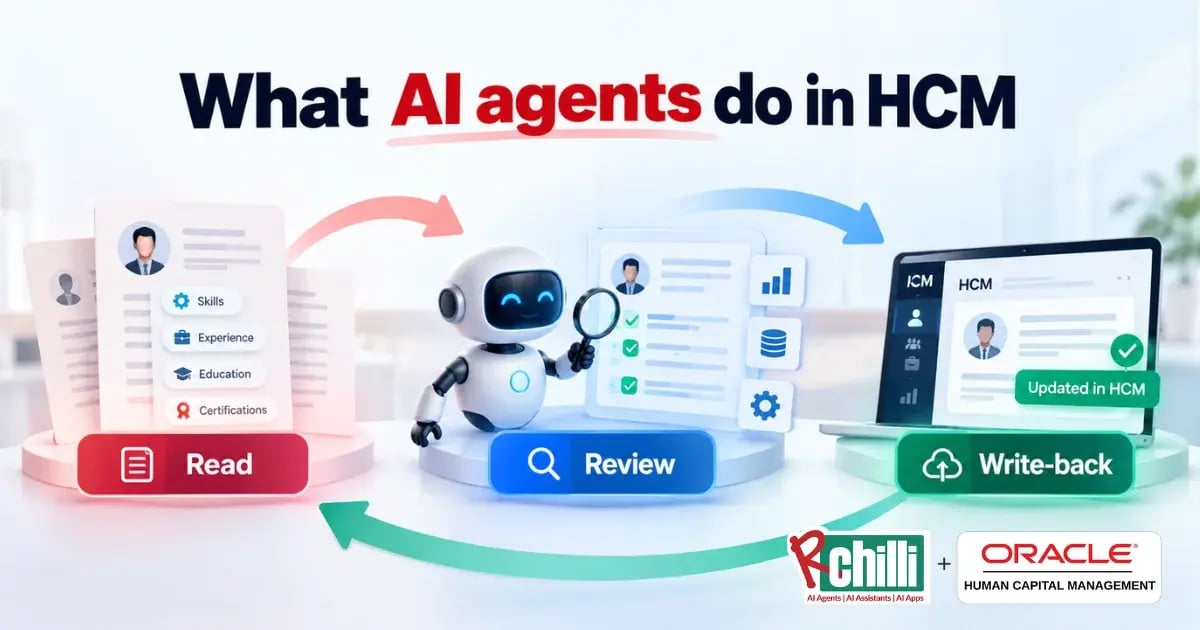
A virtual agent's job is to take a repetitive, rules-heavy task off a person's plate without taking the decision away from them. Good agents follow the same loop:
- Read: pull the job requisition, candidate profile or employee record from the HCM system
- Work: apply AI to score, generate, screen or enrich
- Review: show the output to a recruiter or HR user to approve or edit
- Write back: save the approved result to the right record in the HCM system
If a tool skips step 3, it's making decisions for you. If it skips step 4, your team is still copying and pasting. Both are worth asking about in any demo.
Where are AI agents most mature in HCM?
Recruiting, by a wide margin. The work is high volume, repetitive and measurable: every application needs reading, every role needs a job description, every interview needs questions. That makes it the easiest place to see whether an agent saves real time.
Oracle Recruiting Cloud is a good example of how this works inside a major HCM suite. RChilli runs five AI agents for Oracle Recruiting Cloud, each one built on the read, work, review, write-back loop above:
- Job Description Optimizer AI Agent: generates inclusive, market-aligned job descriptions from requisition details. JD creation drops from 1-2 hours to 5-10 minutes, upto an 85-90% reduction, and applicant relevance improves by upto 10-25%.
- Job Application Analyzer Agent: scores and ranks applications against the requisition and flags skill gaps. Review time goes from 10-15 minutes to 2-3 minutes per candidate, upto a 70-80% reduction.
- Pre-Screening AI Agent: screens resumes and runs text or audio pre-screening interviews. Screening goes from 7-10 minutes to 1-2 minutes, upto a 75-85% reduction, so recruiters screen 3-4 times more candidates in the same time.
- Interview Question Generator AI Agent: builds role-specific technical, behavioral and competency questions from the requisition and the candidate's application. Prep drops from 30-50 minutes to 5-10 minutes per candidate, upto an 80-85% reduction.
- Profile Augmentation - Talent Data Refresh Agent: fills gaps in existing candidate profiles with new skills and certifications. Profile maintenance effort drops by upto 85-90%, and candidate rediscovery improves by upto 20-30%.
None of them makes the hiring call. A recruiter approves every output before it reaches the Oracle record. You can see all five on the AI agents for Oracle Fusion Applications page.
Can AI agents handle onboarding, employee experience and payroll?
Partly, and it depends on the data.
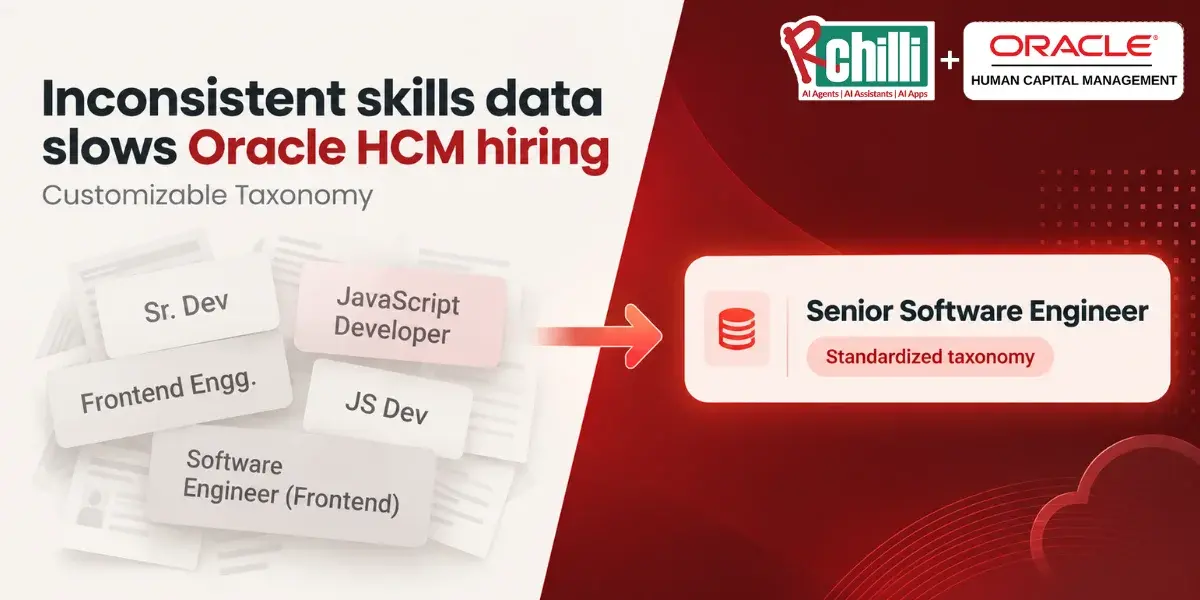
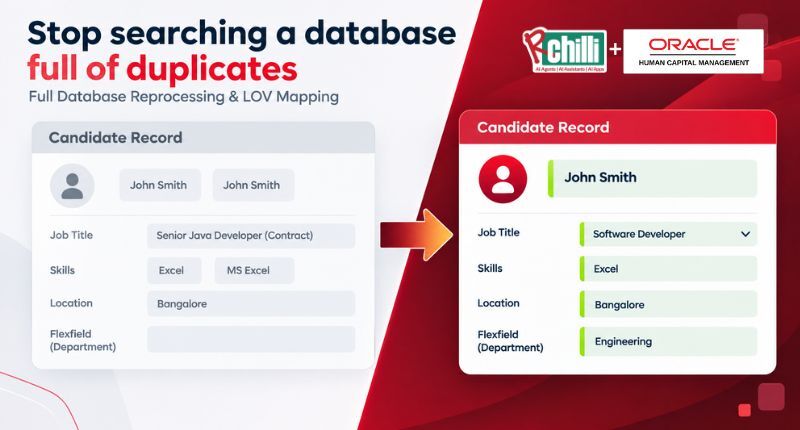
For employee experience, the most useful thing an agent can do is keep records accurate so every other tool works. Clean candidate data at intake carries into the employee record later. That's why RChilli's Oracle work starts with intake: Enhanced Candidate Profile Import turns a resume into a complete, structured Oracle profile, and Employee Profile Update only accepts profile changes from verified senders.
For payroll, agents can answer routine questions and flag records that look wrong. The calculations themselves should stay with your payroll rules engine and the people who own it. Be wary of any vendor that suggests otherwise.
What should a good HCM agent never do?
- Change a record without a person approving it
- Store candidate or employee data it doesn't need after processing
- Use a different set of values than your HCM system, so filters and reports break
- Work outside the system your team already uses
That last one is easy to miss. If recruiters have to open a separate tool, adoption drops and the time saved disappears.
How secure are AI agents inside Oracle HCM?
It's the right question to ask before any pilot. RChilli's agents and integrations for Oracle HCM run on infrastructure certified to ISO 27001:2022 and SOC 2 Type II, with GDPR, HIPAA and PCI compliance. Resume data isn't stored after processing. You can read the details on our data security page.
RChilli is also the default parsing solution for Oracle Recruiting Booster, an extension of Oracle Fusion Cloud Recruiting, and is trusted by Oracle HCM users globally.
Start with one workflow
You don't need to automate everything at once. Pick the task your team complains about most, whether that's screening, job descriptions or interview prep, and measure how long it takes today. That number is your baseline. Every week it stays manual is another week of top candidates waiting in a queue.
RChilli plugs into Oracle HCM to automate candidate profile import, standardize your data and take the repetitive steps out of recruiting, while your recruiters keep every decision.
Book a demo and bring one open requisition. We'll show you which steps an agent can take off your team's plate first.
Related reading: Hire smarter with AI agents in Oracle Fusion Applications and Integration with Oracle Cloud HCM.
FAQ block
What AI-driven features are available for human capital management platforms? Most HCM platforms now offer AI for recruiting (job descriptions, screening, ranking, interview prep), onboarding, employee self-service, talent management and analytics. Recruiting is the most mature area. In Oracle Recruiting Cloud, for example, RChilli runs five AI agents that read Oracle data, do the work and write approved results back.
What is the role of virtual agents in modern human resources management software? Virtual agents take repetitive, rules-heavy HR tasks off people's plates without taking decisions away from them. A good agent reads the HCM record, applies AI to score, generate or enrich, shows the output to a person for approval, and then writes the approved result back to the right record.
What is the difference between an HR chatbot and an AI agent? A chatbot answers questions from a script or knowledge base and doesn't change records. An AI agent completes a defined task inside the HCM system, such as ranking applications or generating interview questions, and writes the result back to the record after a recruiter or HR user approves it.
What are AI agents for Oracle Fusion HCM? They're AI agents that work inside Oracle Recruiting Cloud. RChilli offers five: Interview Question Generator, Job Description Optimizer, Job Application Analyzer, Pre-Screening, and Profile Augmentation - Talent Data Refresh. Each reads Oracle data, produces output for recruiter review, and writes the approved result back to the Oracle record.
How do intelligent assistants improve employee experience in large HR systems? They answer routine questions faster and, when built as agents, keep records accurate so every other tool works. Clean data matters most: a complete candidate profile at intake carries into the employee record, and verified self-service updates keep that record current without manual HR work.
Can AI chatbots automate payroll tasks in enterprise HR solutions? They can answer routine payroll questions and flag records that look wrong. Payroll calculations should stay with your payroll rules engine and the team that owns it. AI adds the most value around payroll by keeping the employee data that feeds it complete and consistent.


Leave a Reply