Oracle HCM LOV Mapping Made Simple
by Lovepreet Singh
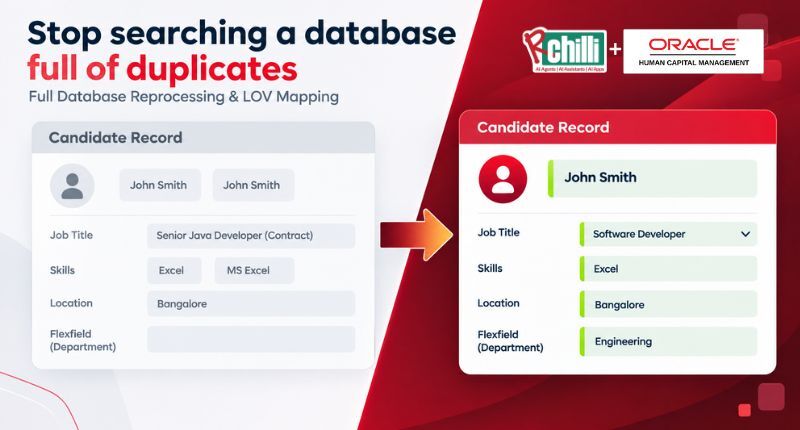
Oracle HCM recruitment workflows work best when candidate and job data is consistent, structured, and aligned with predefined values. List of Values (LOV) Mapping helps standardize free-text and differently formatted information before it moves through recruitment workflows.
RChilli’s List of Values (LOV) supports predefined and customizable values for attributes such as skills, job titles, locations, qualifications, certifications, and licenses. This helps organizations build cleaner candidate profiles, improve data consistency, and create a stronger foundation for efficient Oracle HCM recruitment workflows.
Situation: Building Consistent Oracle HCM Data
Oracle HCM recruitment workflows rely on structured, consistent data. However, candidate information often enters the system from different sources, including resumes, job boards, email, legacy databases, and recruiter-entered records.
The same information can appear in multiple formats.
For example:
- “New York”
- “NY”
- “New York City”
All three may refer to the same location, but the target picklist may accept only one predefined value.
The same issue can occur with:
- Skills
- Job titles
- Qualifications
- Certifications
- Licenses
- Locations
- Competencies
When incoming values do not align with configured values, organizations can face missing fields, inconsistent candidate records, mapping errors, or additional manual cleanup.
RChilli’s ERP customer persona guidance identifies inconsistent candidate data, excessive manual handling, and poor data flow between recruitment systems as recurring challenges for HR Operations and HR Technology teams.
At enterprise scale, these inconsistencies can affect recruiter productivity, candidate search, reporting, matching, and overall data quality.
Industry Standard: Use Controlled Values
A common data-management practice is to replace uncontrolled free-text entries with a governed vocabulary.
Instead of allowing multiple versions of the same term, organizations define an approved value and map related variations to it.
For example:
Incoming values:
Software Engineer
Software Developer
S/W Engineer
Standardized value:
Software Engineer
The principle is straightforward: one concept should resolve to one approved value wherever possible.
This improves consistency across recruitment systems and creates a better foundation for:
- Search
- Filtering
- Matching
- Analytics
- Reporting
- Data migration
- Recruitment automation
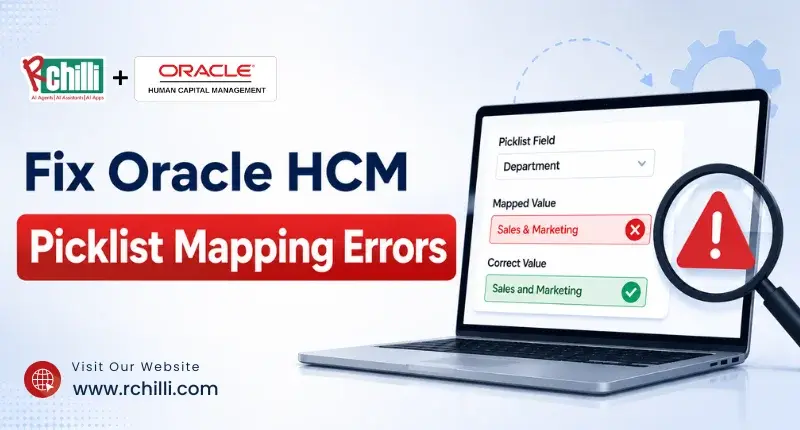
How to Fix Picklist Mapping Errors with LOV Mapping
1. Identify Fields Causing Mapping Errors
Start by identifying attributes that frequently require correction or fail to align with Oracle HCM values.
Review candidate and job data coming from:
- Resumes
- Job boards
- Recruitment databases
- Legacy systems
- External talent sources
Prioritize high-volume attributes such as skills, titles, locations, qualifications, certifications, and licenses.
Understanding where the mismatch originates helps HRIS teams focus standardization efforts on the fields creating the most downstream rework.
2. Define Approved Target Values
Next, establish a controlled set of acceptable values.
RChilli’s List of Values (LOV) supports predefined values for important recruitment attributes while allowing organizations to customize values based on business requirements.
This approach gives HR teams a consistent structure without relying entirely on unrestricted free-text entry.
3. Map Variations to Standard Values
Map known variations of the same term to an approved value.
For example:
Incoming variations:
San Francisco
SF
San Francisco, CA
Mapped value:
San Francisco
This is the core purpose of LOV Mapping: normalize the data before passing it into downstream recruitment workflows.
When candidate and job data follows the same controlled vocabulary, organizations can reduce recurring mapping discrepancies and improve data usability.
4. Validate the Mapping
Before applying mappings at scale, test them against representative candidate and job data.
Look for:
- Unmatched values
- Duplicate terms
- Ambiguous terminology
- Missing categories
- Incorrect standardization
Validation should consider both technical accuracy and recruiter usability.
A technically correct list still needs to support how recruiters search, filter, compare, and evaluate candidates.
5. Maintain the LOV Over Time
Recruitment data changes continuously.
New skills emerge. Job titles evolve. Certifications change. Organizations expand into new regions.
For this reason, List of Values (LOV) Mapping should be treated as an ongoing data-hygiene practice, not a one-time exercise.
Organizations should periodically review and update controlled values to ensure they remain aligned with hiring requirements.
RChilli Offerings: Cleaner Oracle HCM Data
RChilli positions Standardization-Taxonomy (Picklist) within its Data Hygiene capabilities for Oracle HCM.
According to the RChilli Content Creation Playbook, this use case supports unified skill and title standards within Oracle HCM recruitment workflows.
RChilli’s broader Oracle HCM positioning focuses on automating candidate data processes, standardizing recruitment information, and improving workflow efficiency.
With List of Values (LOV), organizations can work toward:
- More consistent candidate profiles
- Better location filtering
- Standardized skills and titles
- Reduced manual data correction
- Improved recruitment data hygiene
- More consistent information across systems
For CHROs, HRIS Managers, HR Operations leaders, and Talent Acquisition teams, this means moving from repetitive data correction toward a cleaner and more scalable recruitment data environment.
Certifications: Build Data Quality on Trust
Data quality is only one part of an enterprise recruitment strategy. Organizations also need confidence in security and compliance.
RChilli’s stated security and compliance coverage includes:
- ISO 27001:2022
- SOC 2 Type II
- GDPR
- HIPAA
- PCI
RChilli’s security documentation also states that resume information is not stored during or after parsing on its cloud servers.
This gives Oracle HCM teams a way to approach recruitment data standardization with an enterprise-focused security and compliance framework.
FAQs About LOV Mapping in Oracle HCM
What is List of Values (LOV) Mapping in Oracle HCM?
List of Values (LOV) Mapping standardizes incoming recruitment data by aligning different representations of the same information with predefined values. It can support attributes such as skills, job titles, locations, qualifications, certifications, and licenses.
Why do picklist mapping errors occur in Oracle HCM?
Picklist mapping errors can occur when incoming candidate or job data uses a value, spelling, format, or term that does not align with the value expected by the target field.
How does LOV Mapping fix picklist mapping errors?
LOV Mapping converts different variations of the same information into a standardized value. This helps reduce inconsistencies before the information moves through Oracle HCM recruitment workflows.
What recruitment data can LOV Mapping standardize?
LOV Mapping can support:
- Skills
- Job titles
- Locations
- Qualifications
- Certifications
- Licenses
- Competencies
RChilli’s Content Creation Playbook identifies Standardization-Taxonomy (Picklist) as a Data Hygiene use case for Oracle HCM.
Can List of Values be customized?
Yes. RChilli’s List of Values can support predefined as well as organization-specific values, helping businesses align recruitment data with their internal requirements.
How does LOV Mapping improve Oracle HCM data quality?
It helps reduce inconsistent values and supports a more uniform candidate data structure. Better consistency can improve filtering, matching, reporting, and downstream recruitment workflows.
Can LOV Mapping reduce manual data correction?
Yes. Standardizing incoming values earlier can reduce repetitive cleanup caused by inconsistent or mismatched recruitment data.
Manual data handling and incomplete candidate records are among the challenges identified for HR Operations teams in RChilli’s ERP customer persona guidance.
How does LOV Mapping help recruiters?
Standardized data can make candidate profiles easier to search, filter, compare, and manage. It also reduces the time recruiters may otherwise spend correcting inconsistent information.
Is LOV Mapping useful for large candidate databases?
Yes. As candidate volumes grow, consistent terminology becomes increasingly important. Controlled values help prevent inconsistent data from spreading across large recruitment databases.
How often should organizations review their List of Values?
Organizations should review their List of Values whenever skills, job titles, certifications, locations, or business requirements change.
Regular updates help keep data standards aligned with current hiring needs.
How does RChilli support Oracle HCM data hygiene?
RChilli supports Oracle HCM with recruitment data automation and standardization capabilities designed to improve data consistency and workflow efficiency. Its Data Hygiene use cases include Standardization-Taxonomy (Picklist).
Is RChilli secure for enterprise recruitment data?
RChilli’s stated security and compliance coverage includes ISO 27001:2022, SOC 2 Type II, GDPR, HIPAA, and PCI.
What is the biggest benefit of LOV Mapping?
The main benefit is consistency. Standardized values help organizations reduce mapping discrepancies and create cleaner data for search, filtering, matching, reporting, and recruitment automation.
Why should Oracle HCM teams fix mapping errors now?
Small data inconsistencies can multiply as candidate volumes grow. Delaying standardization can lead to more manual cleanup, inconsistent profiles, and unreliable downstream data.
Fixing mappings earlier helps organizations build cleaner, more scalable Oracle HCM recruitment workflows.
Standardize Before Errors Scale
Picklist mapping errors may appear to be minor data issues, but across thousands of candidate records they can create significant operational friction.
RChilli’s List of Values (LOV) helps organizations bring consistency to recruitment attributes, reduce recurring mapping discrepancies, and strengthen Oracle HCM data hygiene.
Cleaner data means less rework for recruiters and a stronger foundation for search, matching, reporting, and recruitment automation.
Don’t let inconsistent values multiply across your Oracle HCM environment. Book a demo with RChilli to see how List of Values (LOV) Mapping can help standardize your recruitment data today.


Leave a Reply