

by Amruta Singh
The Hidden Cost of Manual Profile Creation
Every recruiter knows the feeling. A promising resume lands in the inbox, and before you can even evaluate the candidate, someone has to manually key in their name, work history, education, certifications, and skills — field by field — into Oracle HCM. Multiply that by hundreds of applicants per open role, and you're looking at hours of data entry every week that adds zero strategic value to your hiring process.
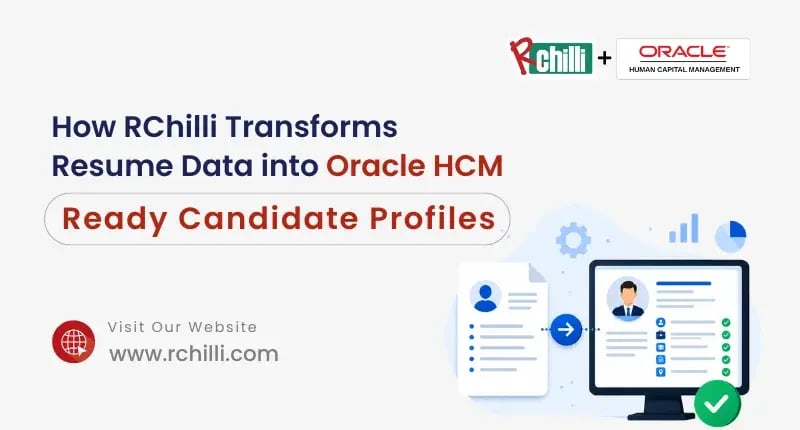
This is the reality for enterprise HR teams still relying on traditional, manual profile creation. And while it may have been the only option a decade ago, today it represents a significant bottleneck — one that slows down hiring speed, introduces data inconsistencies, and leaves recruiters buried in administrative work instead of doing what they do best: identifying and engaging top talent.
The good news? Enhanced Candidate Profile Import is changing all of that — and for Oracle HCM users, the impact is substantial.
What Is Enhanced Candidate Profile Import?
Enhanced Candidate Profile Import goes far beyond a simple resume upload. Rather than attaching a PDF and hoping someone reads it, this approach automatically converts resumes into structured, standardized, and enriched candidate profiles that are instantly ready for use inside Oracle HCM.
RChilli powers this transformation through a suite of capabilities purpose-built for enterprise recruiting workflows:
-
- Accurate data extraction that captures over 30 fields of candidate information — from work history and education to skills, certifications, and languages
-
- Drag & Drop and Email Parsing that lets recruiters import resumes from virtually any source without manual re-entry
-
- Bulk Resume Upload for high-volume hiring, enabling entire applicant pools to be processed at once
-
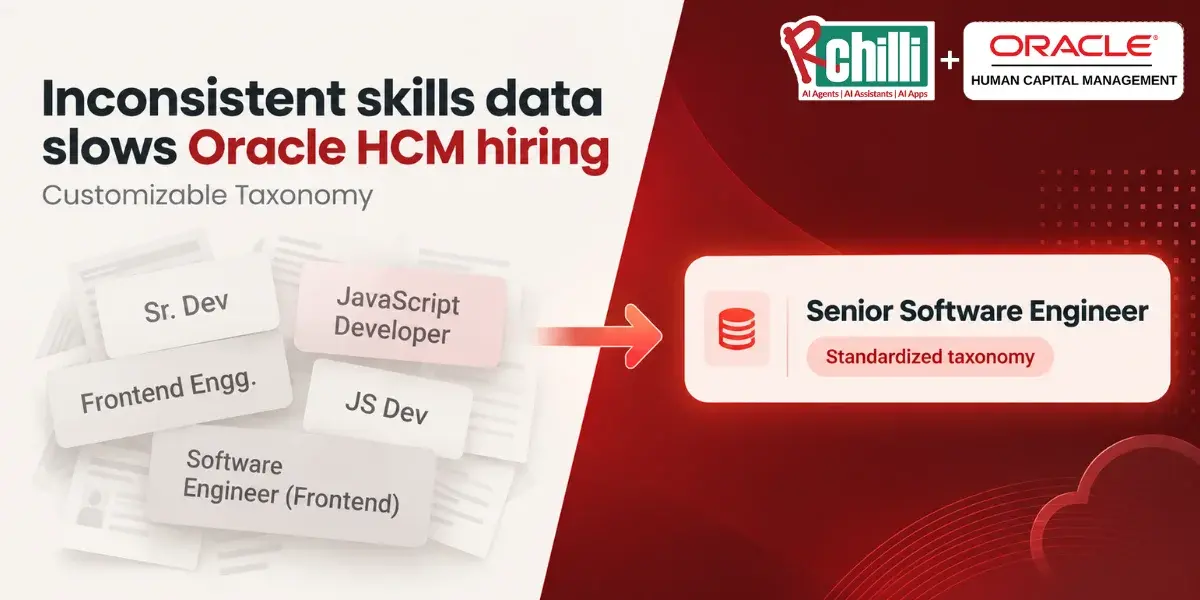
- Customized LOVs (List of Values) for degree mapping, languages, and licenses & certifications — ensuring your data fits Oracle HCM's specific taxonomy
-
- Skills-based hiring support with 15+ skills categories mapped and normalized for structured evaluation
-
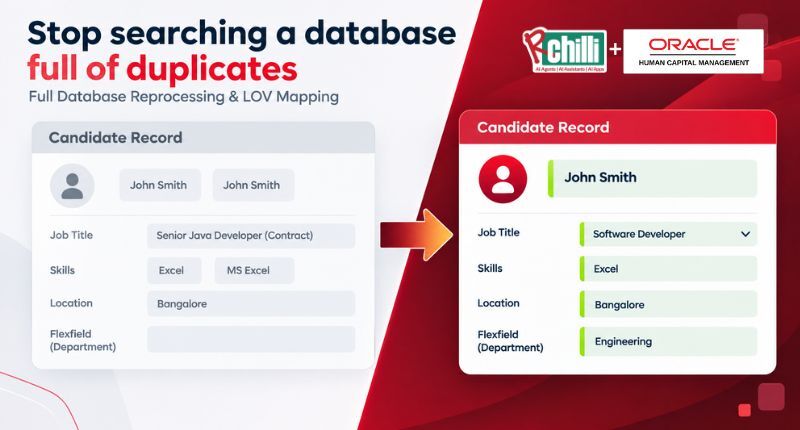
- Deduplication to prevent duplicate candidate records from polluting your database
-
- Full Database Reprocessing to refresh and standardize historical records already in your system
-
- Templated Resumes that create a consistent presentation layer across all candidate profiles
-
- Parsing Logs and Reports so your team maintains full visibility into import accuracy and volume
-
- RChilli MyAccount Access and direct support for ongoing configuration and optimization
The result is a candidate profile that enters Oracle HCM already clean, complete, and ready for screening — not one that requires additional cleanup before it can be used.
Manual Profile Creation vs. Enhanced Candidate Profile Import
For Oracle HCM teams weighing whether to modernize their intake process, the differences are stark:
|
Comparison Area |
Manual Profile Creation |
Enhanced Candidate Profile Import |
|
Data Entry |
Recruiters enter details manually, field by field |
Resume data is extracted and mapped automatically for all flexfields. |
|
Profile Quality |
Often incomplete, inconsistent, or formatted differently by each recruiter |
Structured, standardized, and enriched profiles every time |
|
Recruiter Effort |
High manual workload, especially during peak hiring |
Significantly reduced repetitive work — recruiters focus on evaluation |
|
Searchability |
Limited due to inconsistent job titles, skill labels, and experience formats |
Better search results through normalized skills, titles, and experience data |
|
Oracle HCM Readiness |
Requires cleanup and correction before profiles are usable |
Profiles enter Oracle HCM clean, mapped to your LOVs, and screening-ready |
|
Duplicate Handling |
Requires manual review to catch and merge duplicates |
Automatic deduplication keeps your database accurate |
|
Hiring Speed |
Slower candidate intake creates delays in shortlisting |
Faster profile creation means earlier screening and reduced time-to-fill |
This isn't just an efficiency comparison — it's a data quality story. When candidate profiles enter Oracle HCM in a consistent, normalized format, downstream processes improve too: search accuracy increases, reporting becomes more reliable, and automated workflows like candidate scoring and role matching work the way they were designed to.
Why Data Quality at Intake Matters More Than You Think
Most HR technology investments focus on what happens after candidates are in the system — interview workflows, assessments, offer management. But the quality of everything downstream is directly tied to the quality of data at intake.
When a candidate's skills are entered inconsistently — "project management" in one profile, "PM" in another, "Project Mgr" in a third — your Oracle HCM search returns incomplete results. When education history is missing or malformatted, automated screening rules fire incorrectly. When duplicate profiles exist, candidate history is fragmented across records.
Enhanced Candidate Profile Import solves these problems at the source. By capturing, standardizing, and enriching candidate data the moment it enters your system, RChilli ensures that Oracle HCM has the clean, structured foundation it needs to function at full capability.
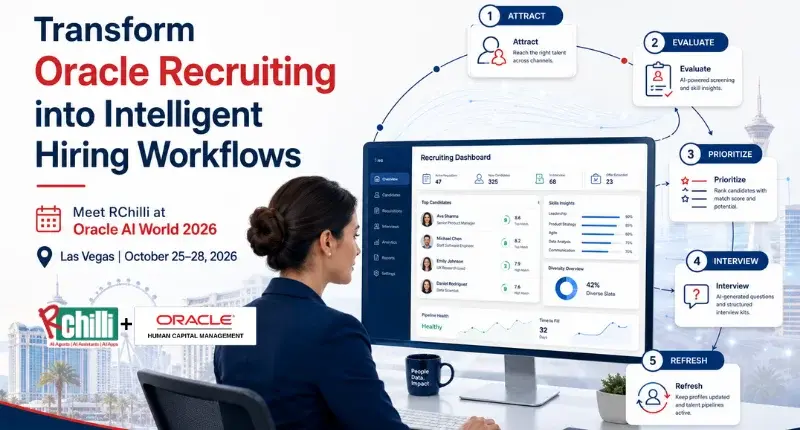
This is especially important for teams that rely on Oracle's recruiting automation features — automated profile creation, candidate data normalization, and candidate intake workflows all perform better when the underlying data is accurate and consistent from the start.
A Simplified Apply Flow That Benefits Everyone
One underappreciated benefit of Enhanced Candidate Profile Import is what it does for the candidate experience. When candidates can submit a resume through a simplified apply flow — without being asked to manually re-enter everything already on their resume — drop-off rates decrease and application volume improves.
For Oracle HCM users, RChilli's integration supports a streamlined candidate journey: a resume is submitted, instantly parsed, enriched, and mapped into a complete Oracle profile — all without the candidate or recruiter having to duplicate effort.
The result is a faster, more professional application experience that reflects well on your employer brand while simultaneously reducing the administrative burden on your recruiting team.
Built for Oracle HCM: Not a Generic Tool
It's worth emphasizing that RChilli's Enhanced Candidate Profile Import isn't a one-size-fits-all resume parser retrofitted for enterprise use. It's built specifically to align with Oracle recruiting workflows — including Oracle's data structures, field mappings, and LOV configurations.
Features like customized degree mapping, language normalization, and license and certification categorization are designed to match exactly how Oracle HCM organizes candidate data. Parsing Logs and Reports give admins full audit trails. Full Database Reprocessing means even legacy candidate records can be brought up to the same quality standard as new imports. And direct RChilli support ensures your configuration stays optimized as your hiring needs evolve.
The Bottom Line
Manual profile creation made sense when there was no alternative. Today, it's a bottleneck that costs your recruiting team time, introduces data inconsistencies, and slows down hiring across the board.
Enhanced Candidate Profile Import — powered by RChilli and built for Oracle HCM — gives enterprise HR teams a better starting point: cleaner data, faster intake, and candidate profiles that are ready to work with from the moment they enter your system.
If your team is still spending meaningful time on data entry before a single candidate can be evaluated, it's time to move from data capture to profile readiness


Leave a Reply